Project Description
I completed this project while working on a website for an extremely well-known British intellectual property; with books, movies, theatre and more, all stemming from the original creation. This website was a place for the superfans; an original content-centred repository for everything you wanted to know about the story behind the story, with teams of writers pumping out new articles multiple times per week.
It was surprising (to me) that this organisation did not have a UX function in place before I joined, and I was brought on as a one-person UX function fitting in alongside the Agile development team. My role was as a UX Designer, but also an educator — helping transition the currently totally autonomous development team into a collaborative function alongside research and design.
The brief
Create a digital book club where new and old readers alike can read along with each other, and discuss key themes and story points from the series. Important points to consider:
The book club should be accessible to new readers and superfans — and anyone in between
- New people continually pour into this franchise; it has a huge following, is incredibly popular, and its first fans are now at the age that they’re sharing it with their children
- There’s a loyal base of superfans who love to enjoy the books (and movies and so on) over and over again, who will look for any opportunities to get something new out of the published works
- There was a desire to bring people together; engage the newbies and the superfans as mentee to mentor, let people share their excitement as they discover the books for the first time, and provide a platform for the superfans to speculate on hidden meanings
Not everyone who knows and loves the franchise is aware of the website and its contents
- Previous research had shown that many people who are big fans of the franchise were not actually aware the website existed
- When people did navigate to the website, it was sometimes seen as unapproachable; there was already so much information, “so where do I start?” (this was another issue to be dealt with, looked at separately!)
- There is an identity associated with some of the more intense users; a superiority and feeling of exclusivity that keeps them engaged — this identity could be shattered with more widespread use
Fans want to get to the point
- While the franchise is very whimsical (even magical…!), previous research had shown that readers wanted to get to the point — like reading non-fiction or news stories, they wanted to discover what new information there was to glean without fluff or faffing
Mobile and tablet use is prevalent
- We can’t rely on users coming to the book club through desktop only, but we do need to get across a large amount of information in various formats to keep people engaged
And finally, the underlying identity that everyone on the team worked to:
- Irresistible and intuitive experiences that visually and functionally delight customers: imagination; innovation; authenticity; enterprisingness; and accessibility
The approach
I’ll preface this by saying that due to some pretty catastrophic personal life events, I had to leave this contract before this project reached fruition. That being said, I can talk you through my approach up until that point, and the plans I’d made for next steps.
Responsive navigation
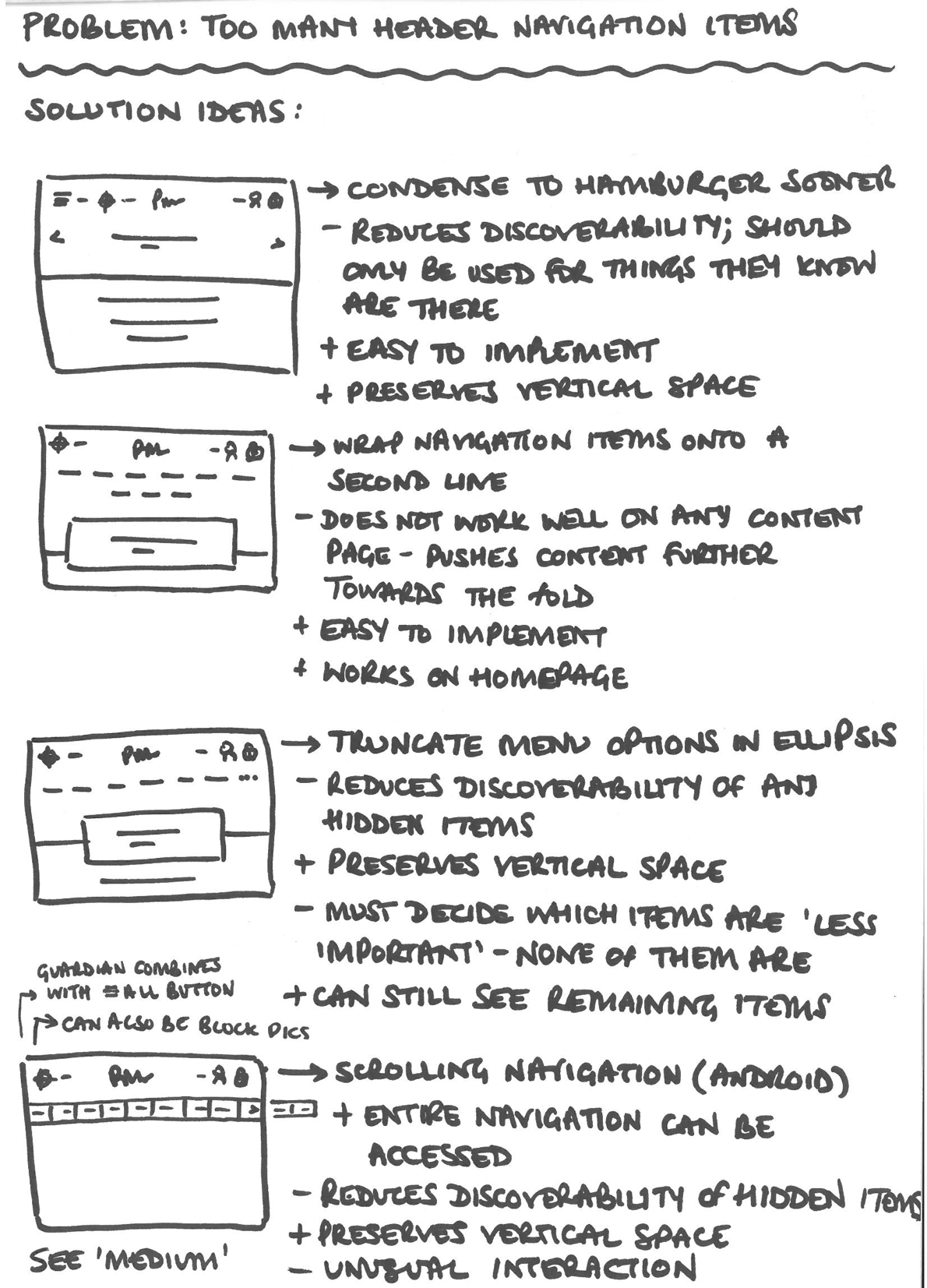
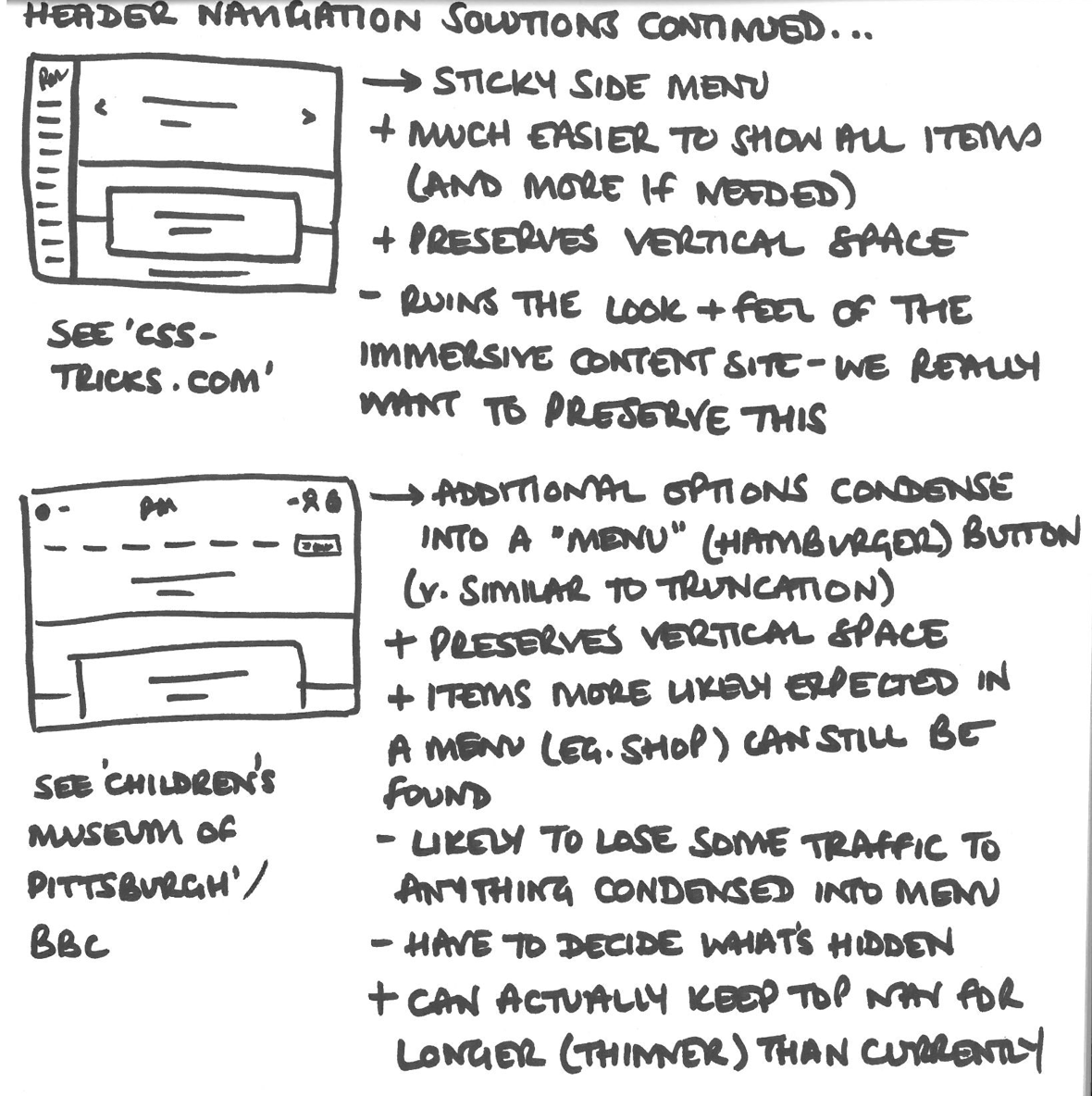
One port of call was to take a look at the navigation. This was slightly separate to the rest of the process because it didn’t rely on research; I knew that if we were adding a new section to the website, we’d need to get users to it. The immediate challenge was that there was already quite a lot in the header navigation, and this needed to scale effectively across different devices to ensure users found what they were looking for. As a new feature, the book club option in the header would also generate interest when returning users noticed a new option, or simply when the label caught people’s eyes. You can see some of my scribbled-out thought process below!
Once I’d weighed up the best approach, I mocked this up in high fidelity across multiple responsive breakpoints for use in forthcoming research.
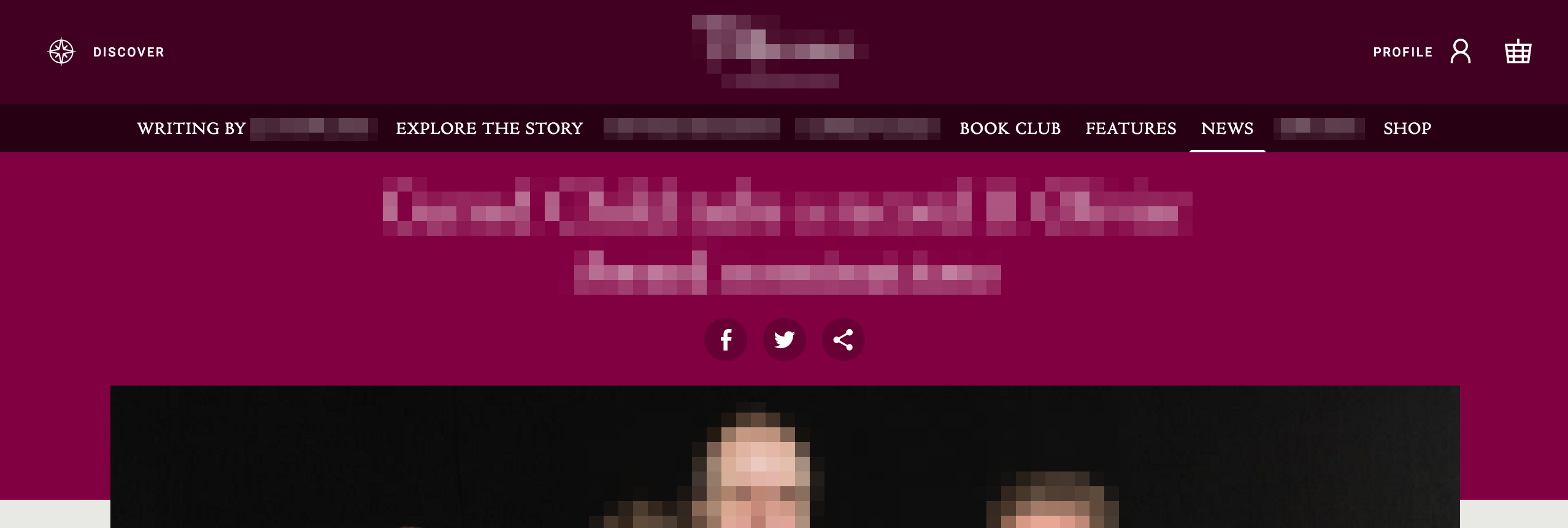
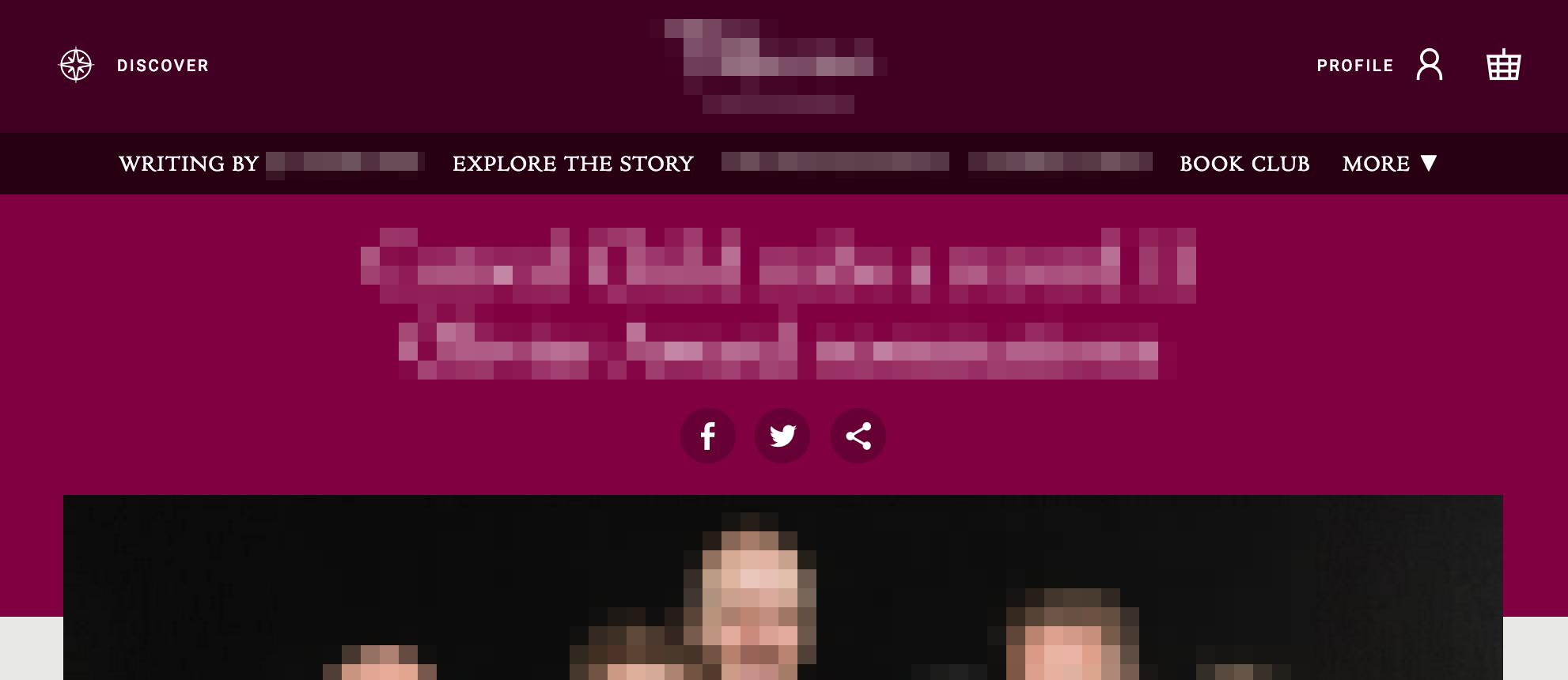
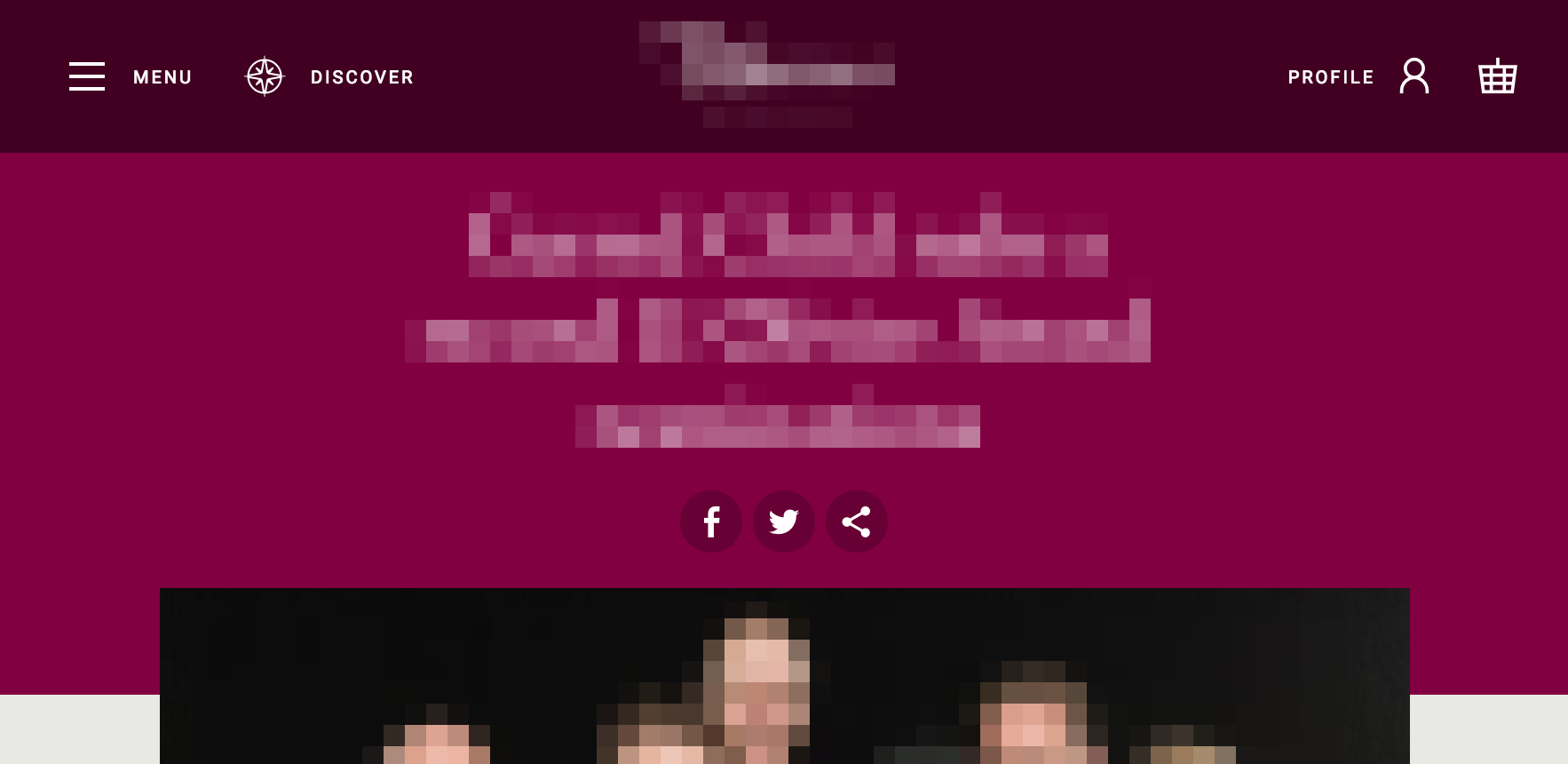
New navigation options and layouts across web, tablet and mobile
Page & content ideas
While I had a whole lot of ideas about what could be done with this online book club — and could learn from some of the previous research that had been done — I knew that I’d definitely need to do some (ideally large scale) user research if this was going to be successful.
To execute this large scale research, I was definitely going to be looking at a quantitative survey of existing and potential members; so it was important to ensure this survey covered everything I might want to learn about to avoid multiple (expensive) rounds. I started by brainstorming everything I thought this book club could do — also involving colleagues and referencing earlier research and personas.
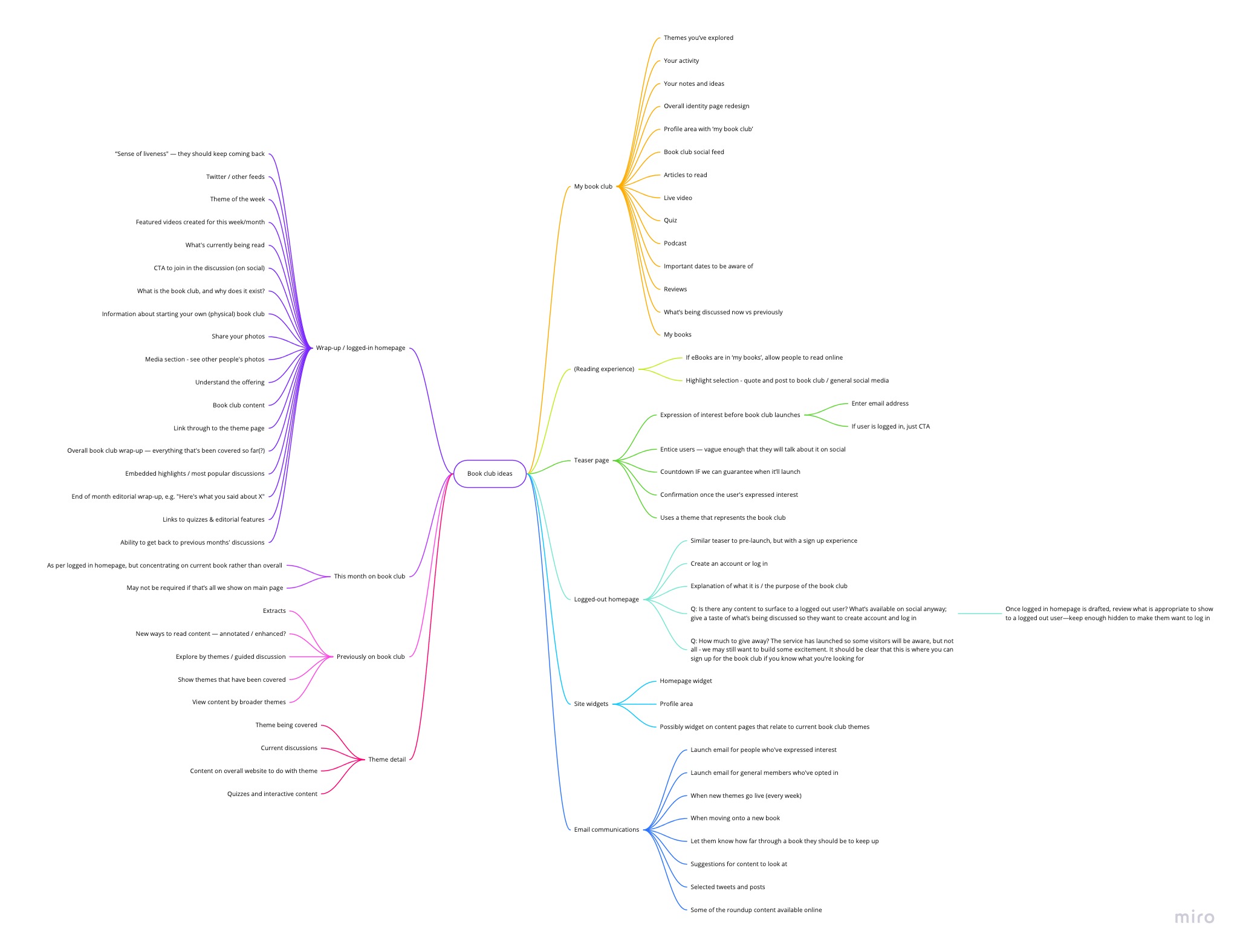
Very large — opens in a new window
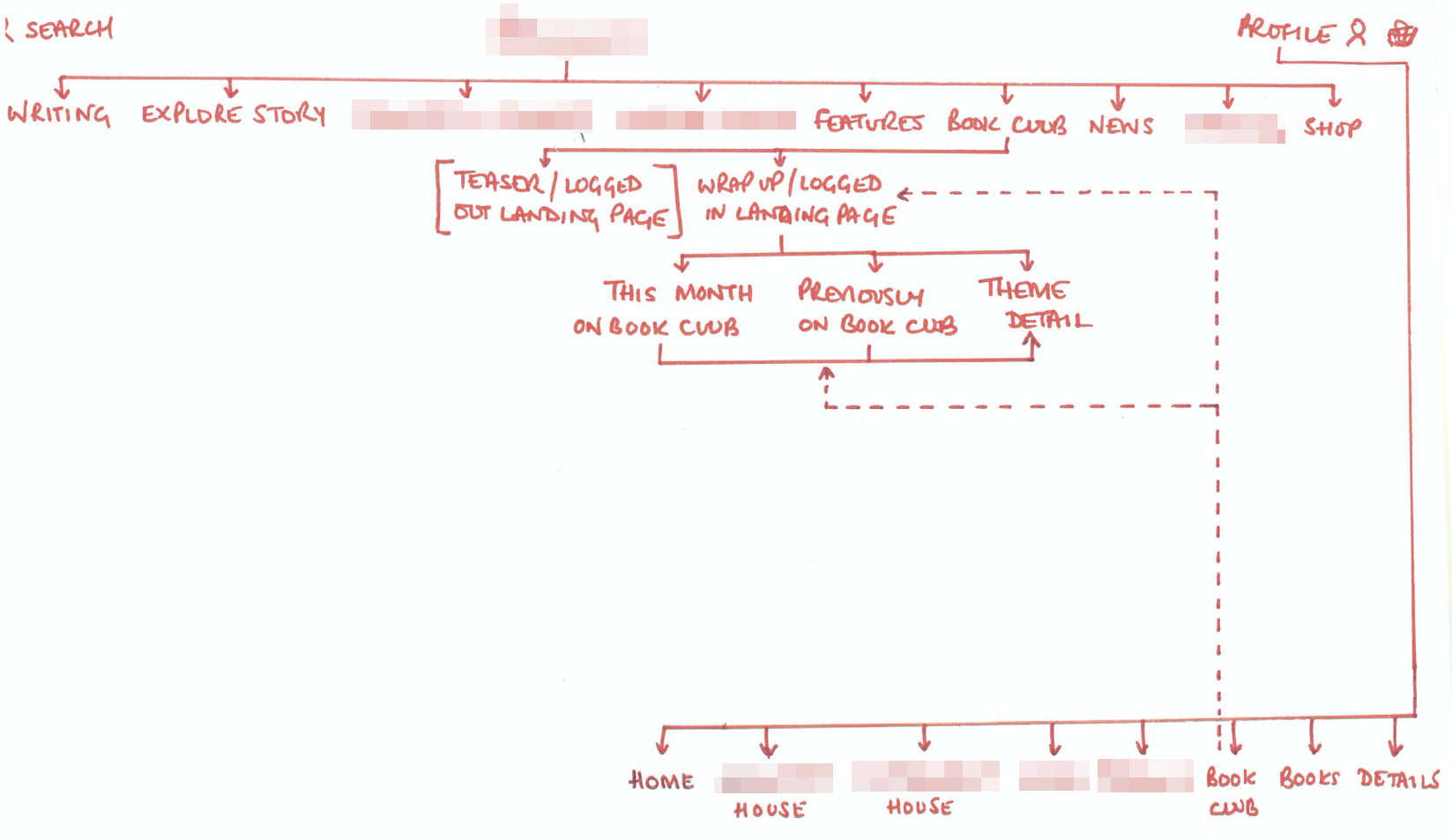
To ensure this was practical within the constraints of the existing website, I also quickly mocked up how the new site structure would look with the book club built in. This uncovered some additional areas (e.g. logged-in member areas) from which the book club could be discoverable, and where it could be promoted.
User journeys
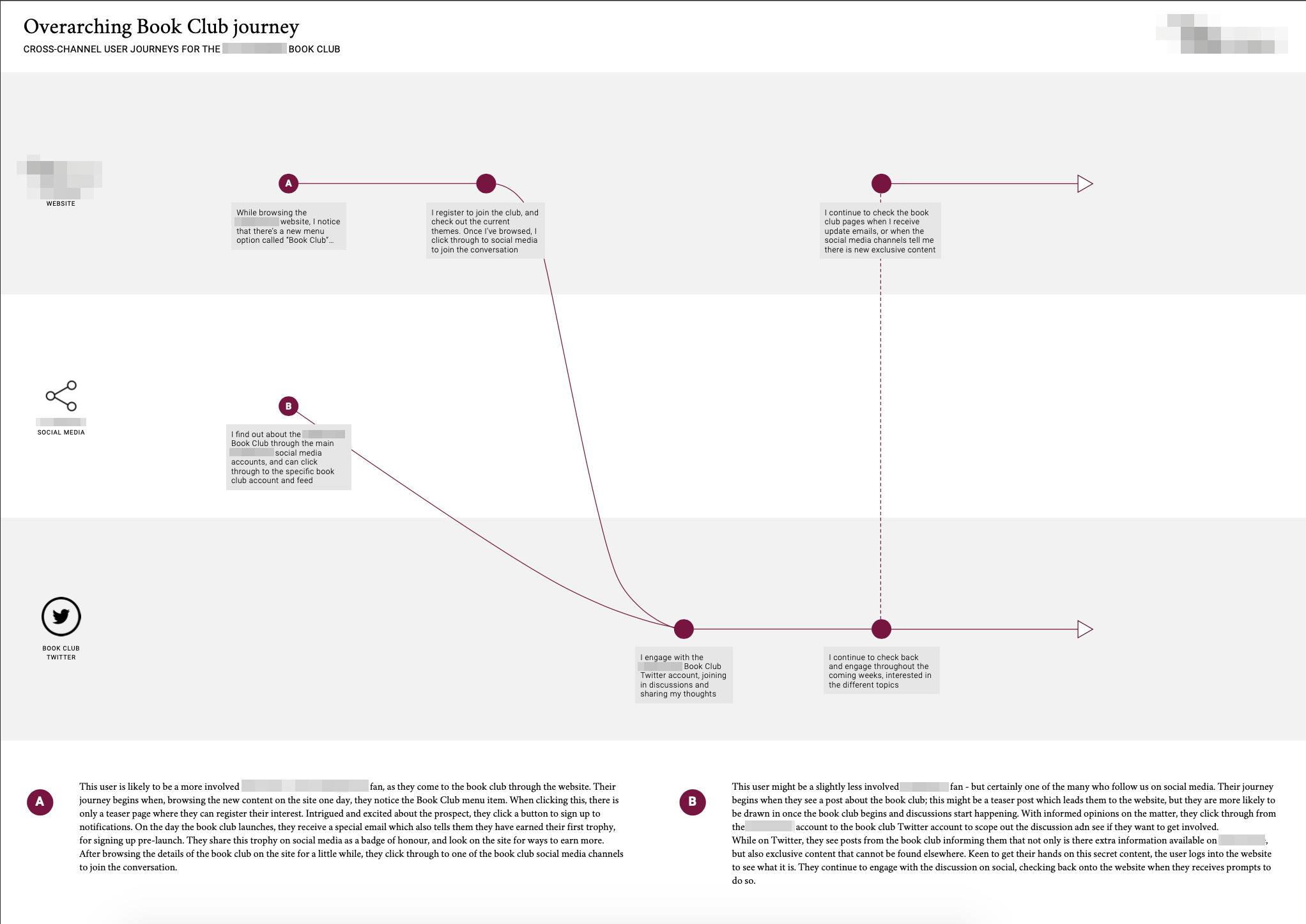
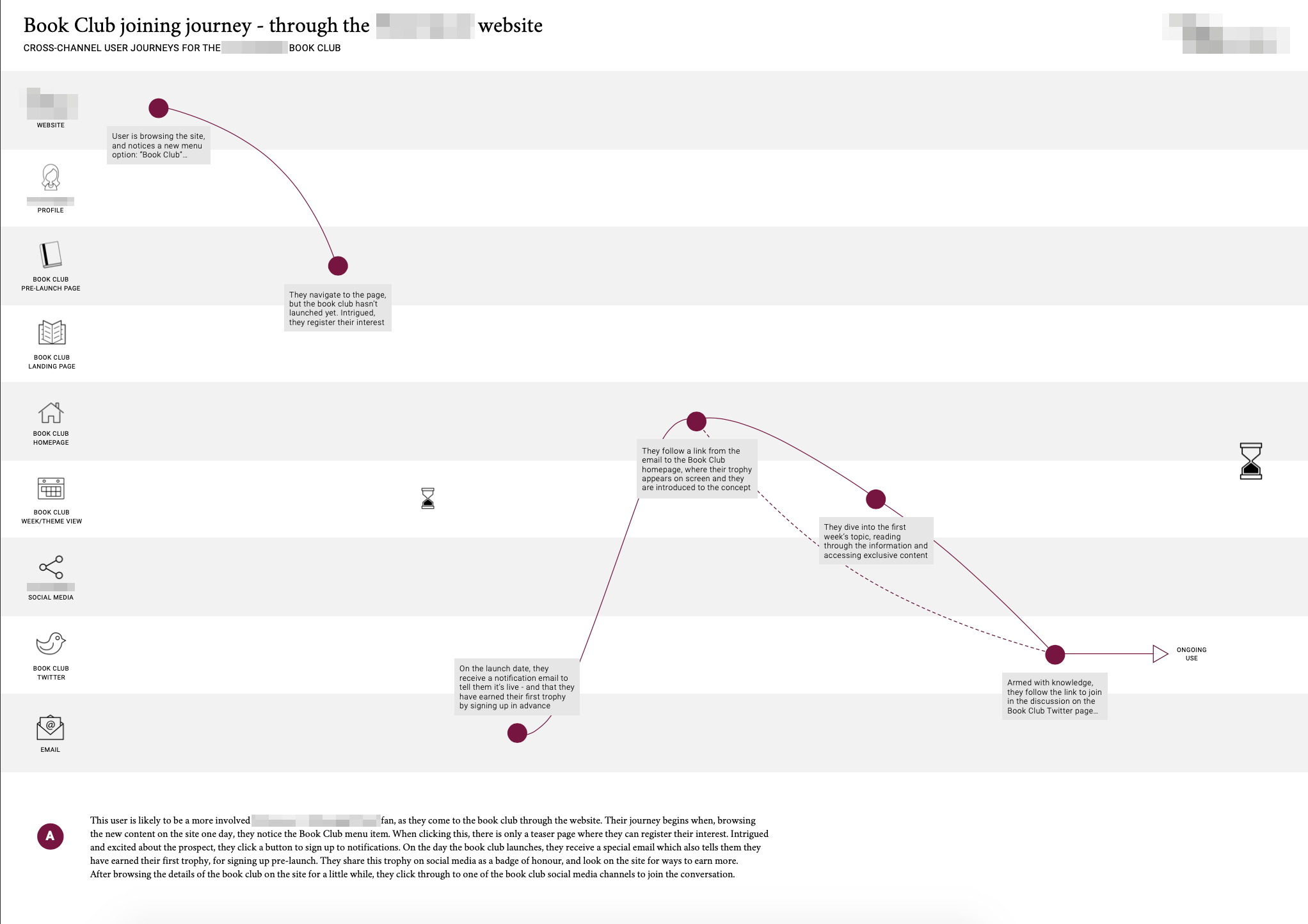
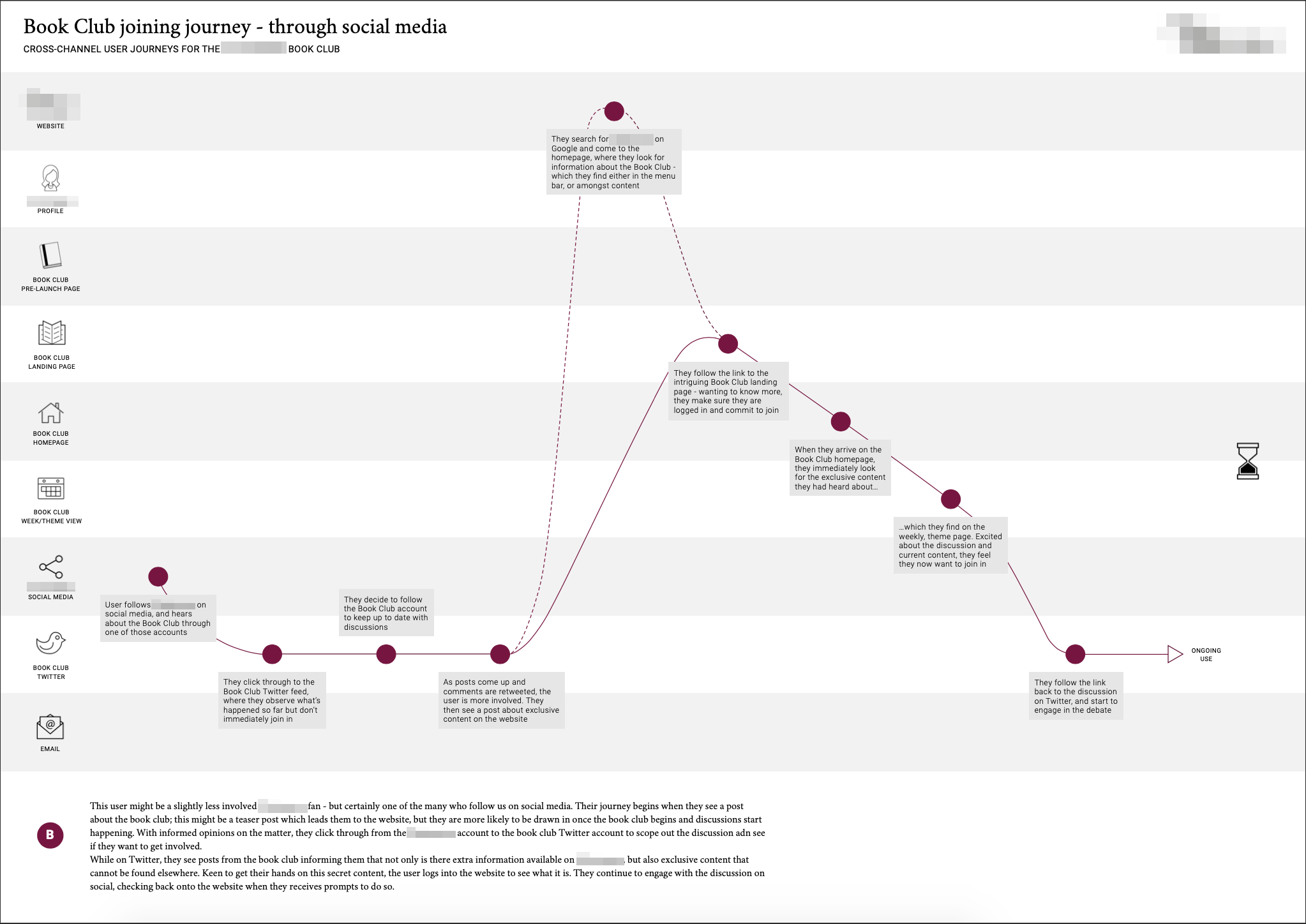
Next, I considered the different ways that users might become aware of, sign up for, and be involved with the book club based on the existing site structure and setup so that I could validate whether this was feasible and achievable in the research. I created an overarching journey, and then three deep dive journeys to look at specific sign-up and participation journeys.
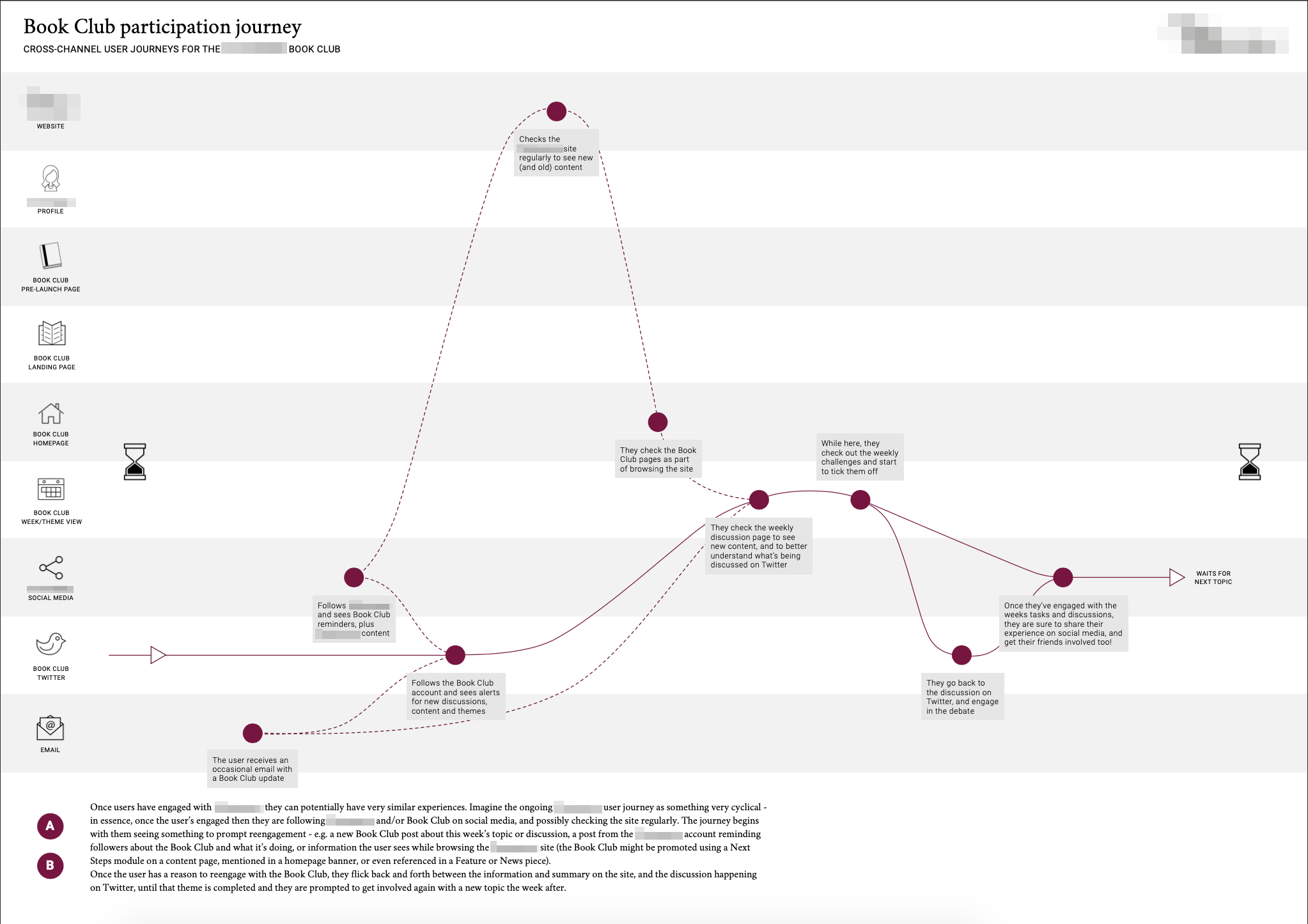
Research plan
Now that I knew roughly what I wanted to ask people about, I met with the company’s dedicated researcher to draft a research plan. I provided her with the following guidelines for recruitment and questions we wanted to answer:
Recruitment requirements
- Would like some people who have been involved in book clubs, especially online ones (don’t need loads)
- Recruitment from all profiles, with emphasis on ‘super-fans’ and ‘newcomers’
- Need mostly people who have social media accounts on Facebook or Twitter, as they’re the ones who could be involved, but also include a few who don’t to understand whether we could keep them engaged
- Understand how much they use these networks
- US and UK audiences
What people expect and want from the book club
- If the company said, “we’re launching a digital book club”, would they be interested?
- What would they expect the online book club to have and do? What would they want it to have or do?
- Are people involved in a book club at the moment — especially a digital one? If so, what do they like or not like about it?
- If the discussion happens on Facebook/Twitter, what do they expect/want to be on the website?
- What would users expect to be in their profile area regarding the book club?
- How do they expect the book club to be integrated with the rest of the site?
- Would users engage with a book club on social media?
- People who use Goodreads — do they engage in discussions? If so, what’s good or bad about these?
- Where do users place the book club on the site? E.g. main navigation vs. profile area
- What do they expect to be available for logged in vs. logged out users?
Assumptions I made — to test
- People will use Twitter and/or Facebook to interact with the book club
- They’ll want to see a roundup of activity for the week’s discussions and featured / notable discussion points
- They’ll log into or create a member account to access the book club roundup and hub — especially if there’s exclusive content and discussions
- One topic per week, or one book per month, feels like the right pace
- The book club should have an archive of previous weeks’ discussions
- Users do not expect to be able to read the book online through the book club
- If the user receives achievements and awards for their involvement, they will want to share these socially
- Users expect to be able to track their book club involvement on the website (in their profile area)
- Users will want to use book club themes to explore other content on the website
- Users want to receive regular emails updating them about the book club’s progress, and showing them relevant content
The researcher took this list away to draft an online survey to be sent out to members and recruited non-members, while I worked on the stimuli…
Wireframes / research stimuli
Finally, I set to work creating some wireframes. These were used to validate some ideas for myself (and see how everything could possibly fit together), to validate the ideas with the development team (there’s no point researching something further if it’s technically unachievable!), and finally to use in some of the research as stimuli to gauge appetite. You can see below some of my whiteboard and paper sketches, moving onto mid- and high-fidelity designs for the stimuli.
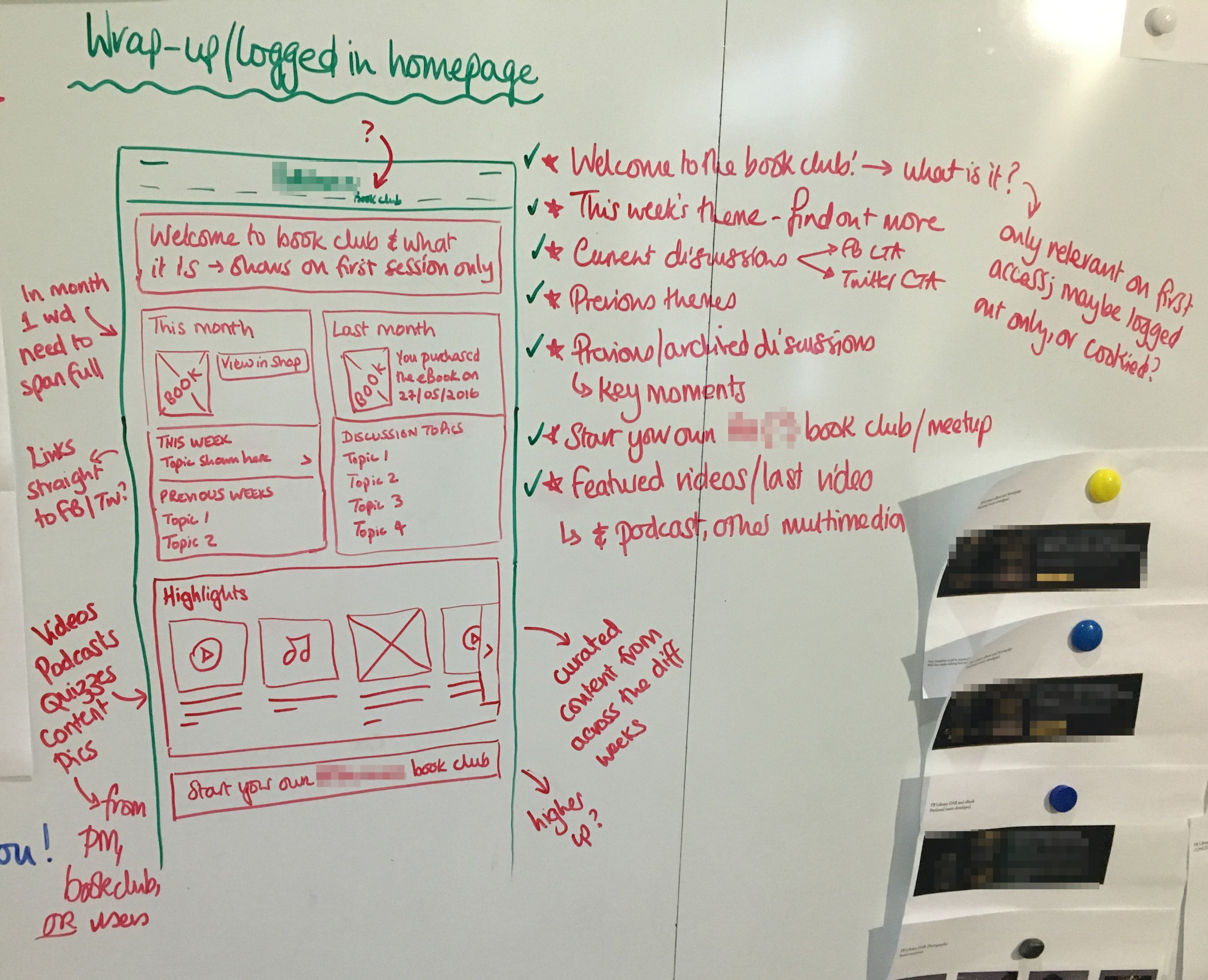
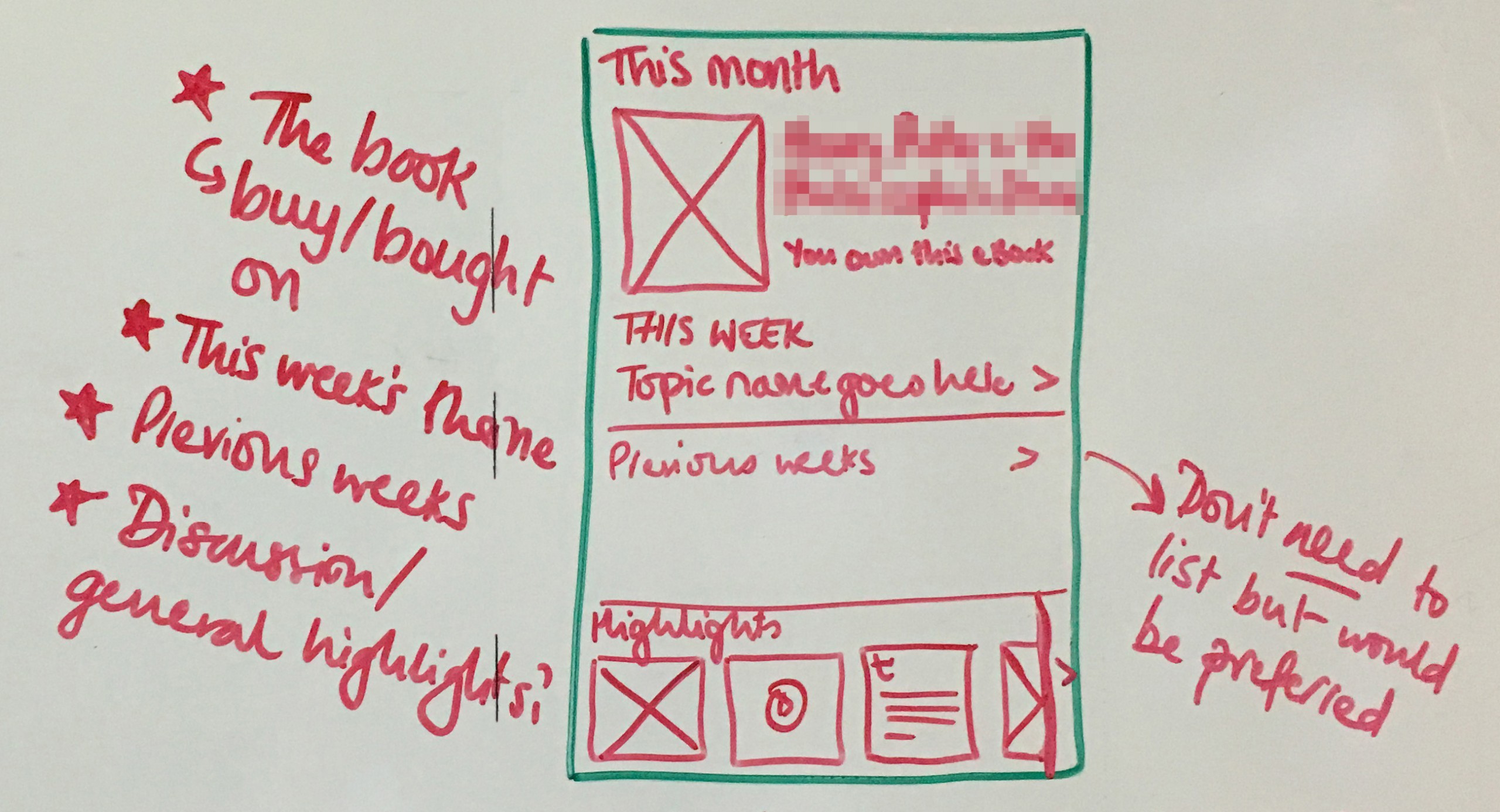
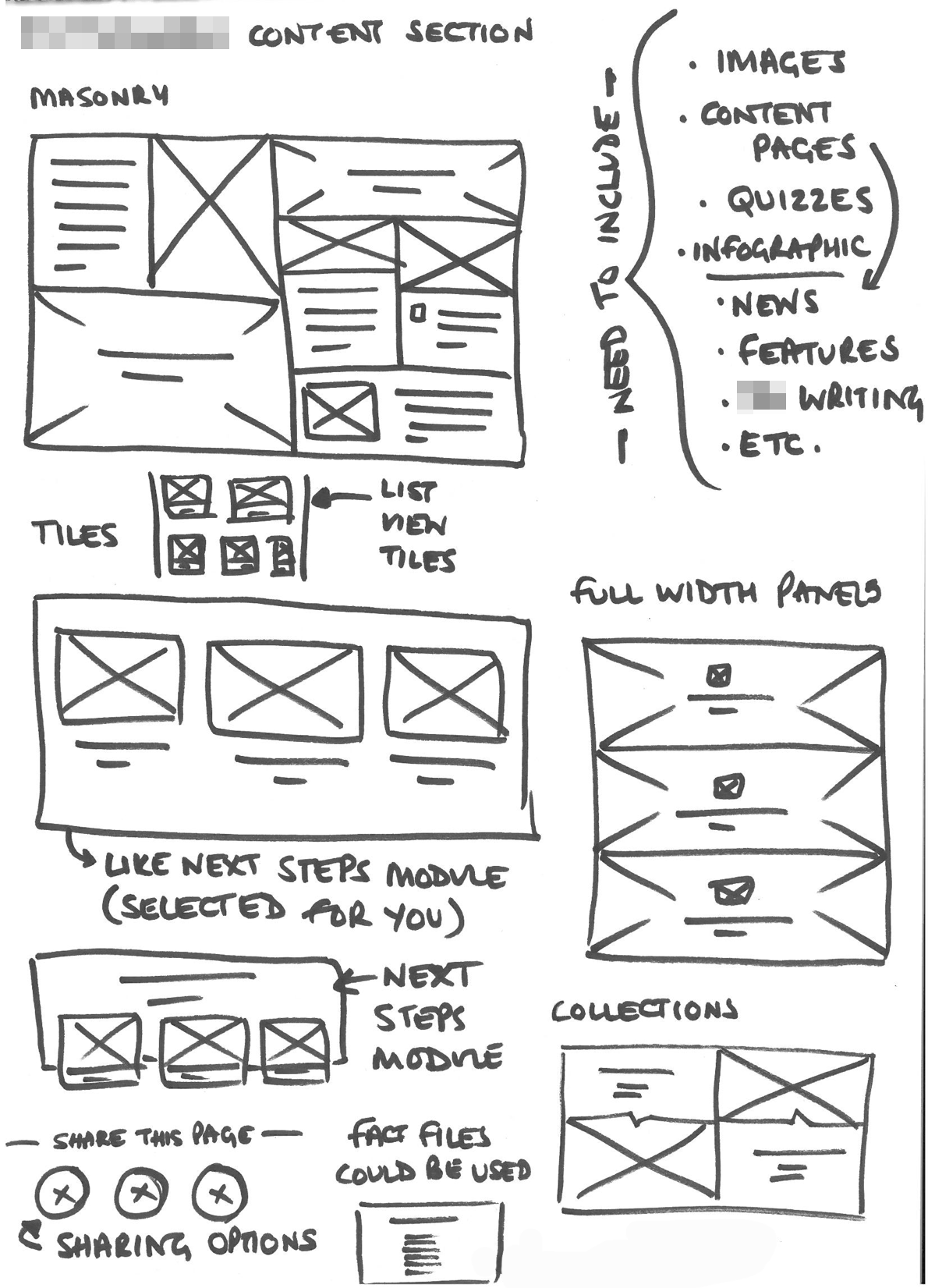
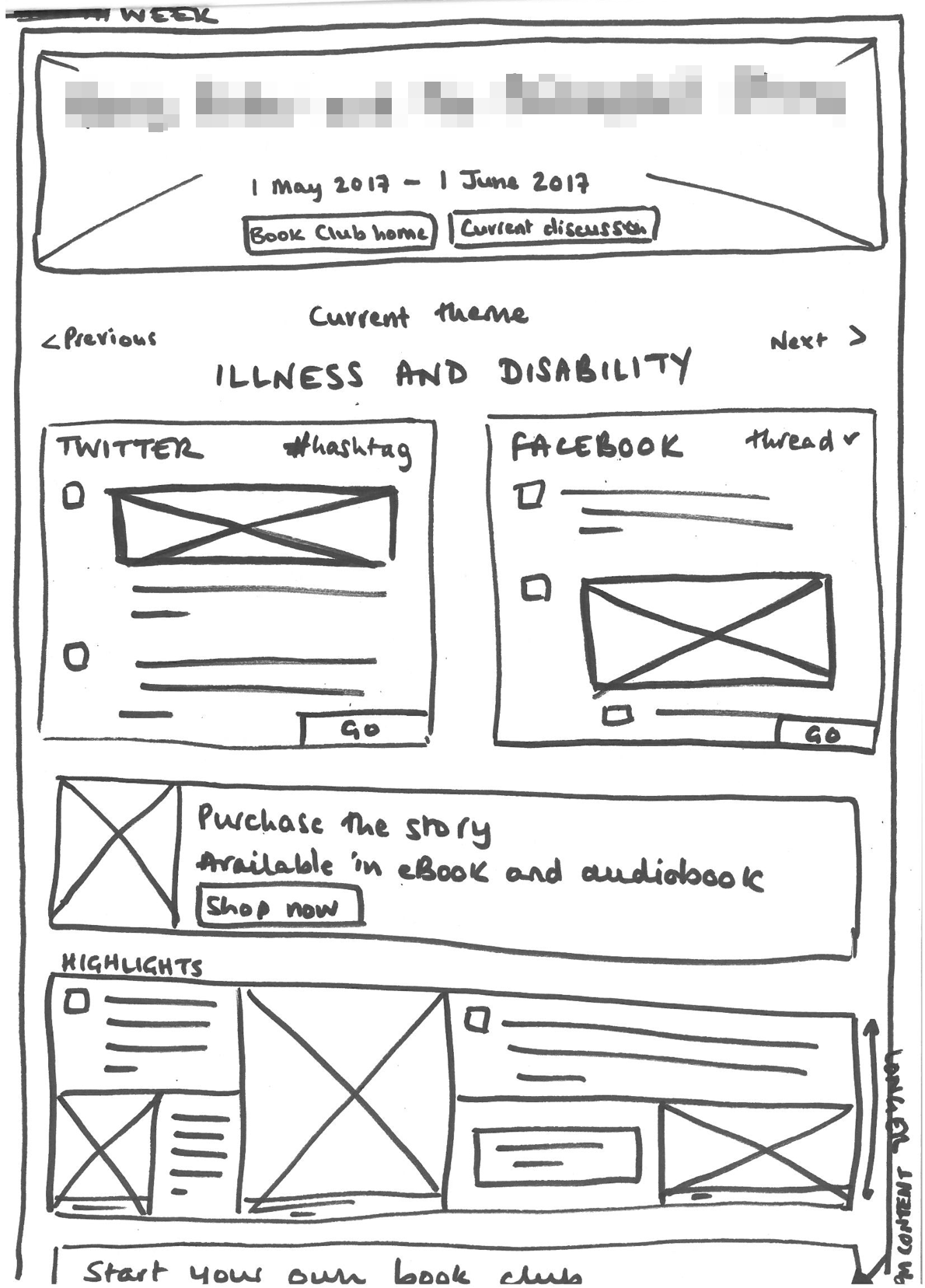
Whiteboard and paper sketches of potential screens and components
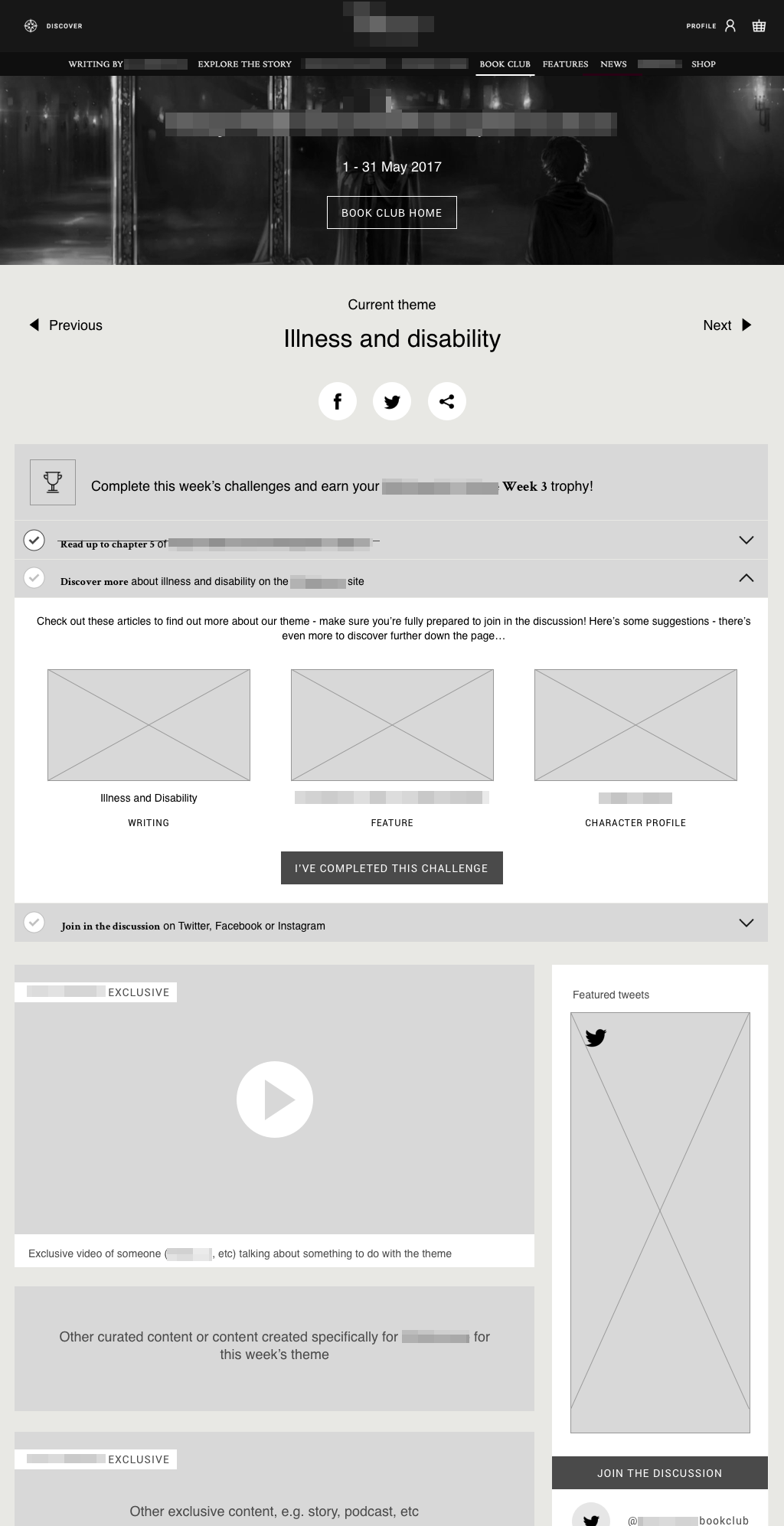
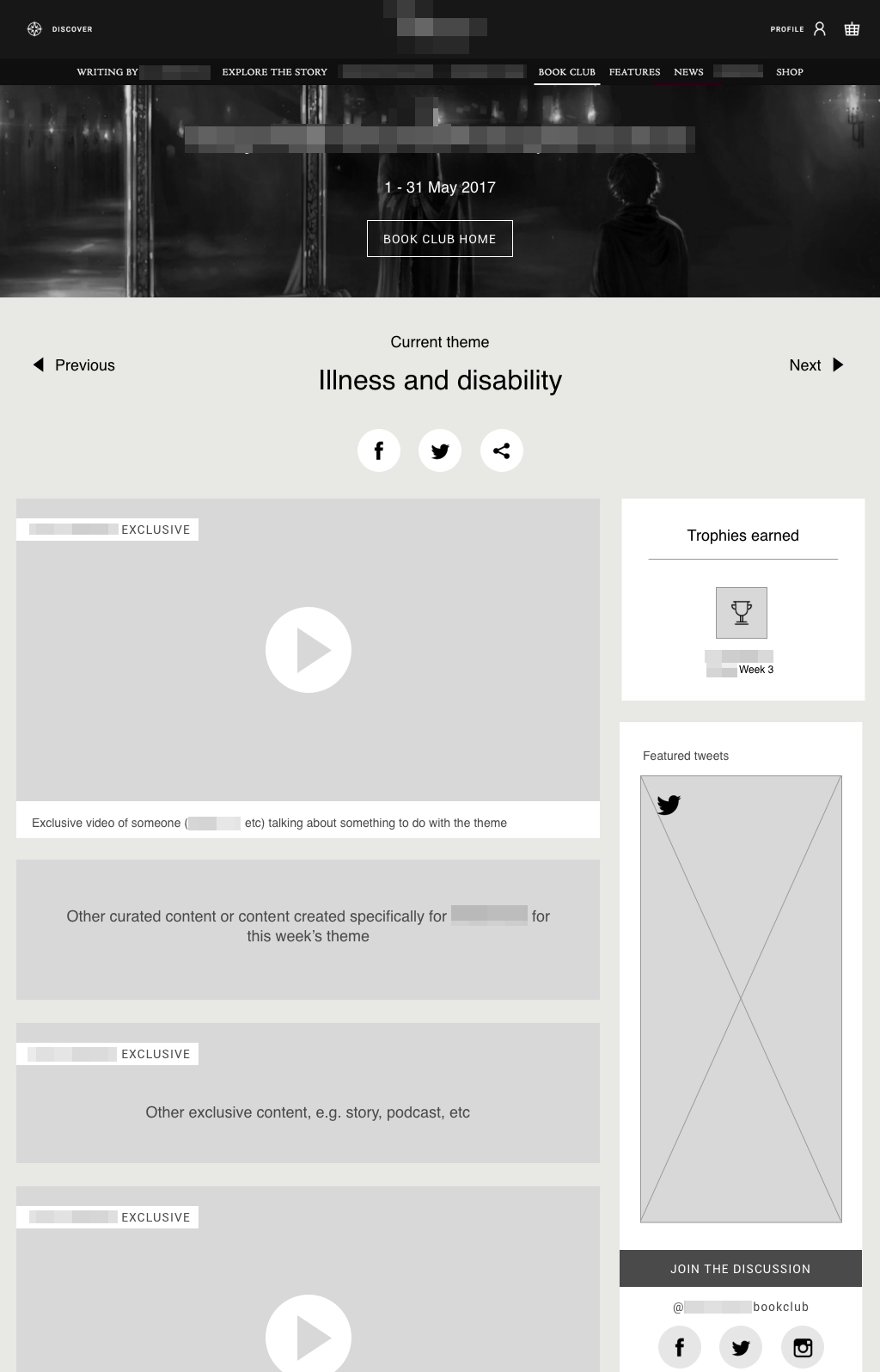
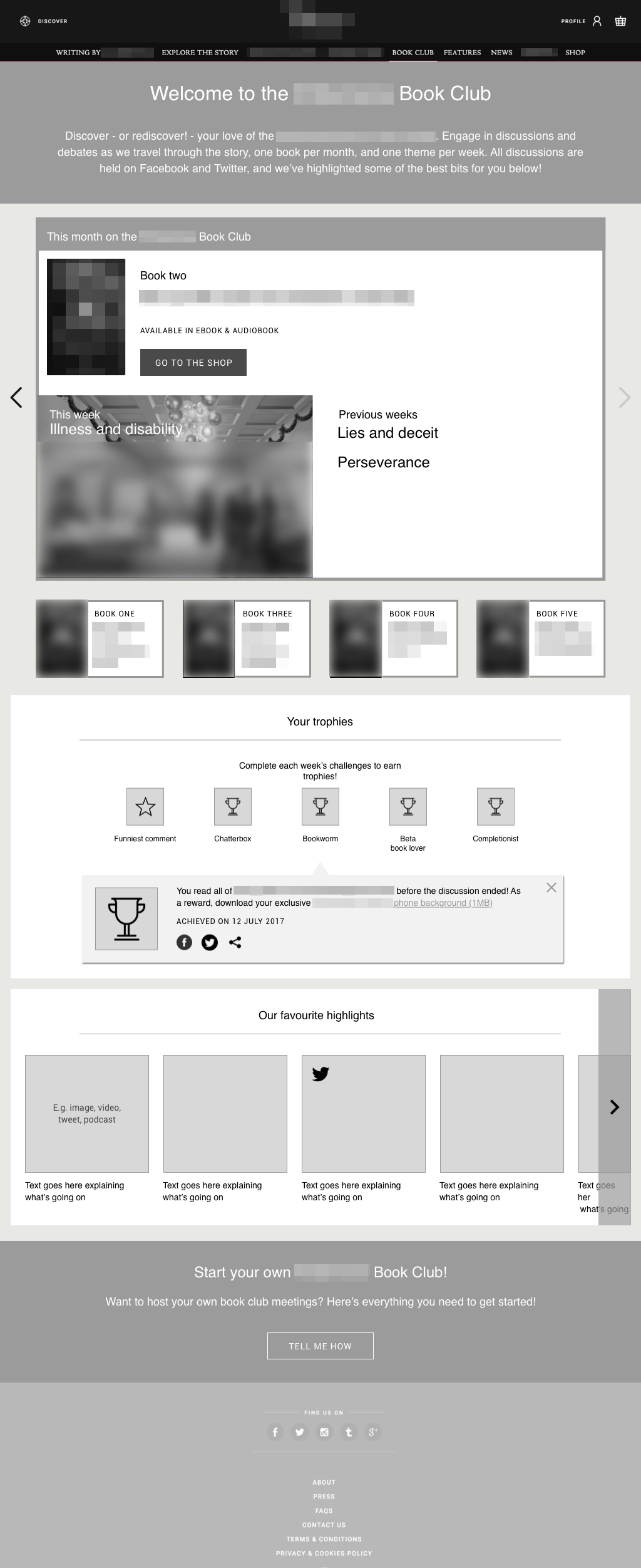
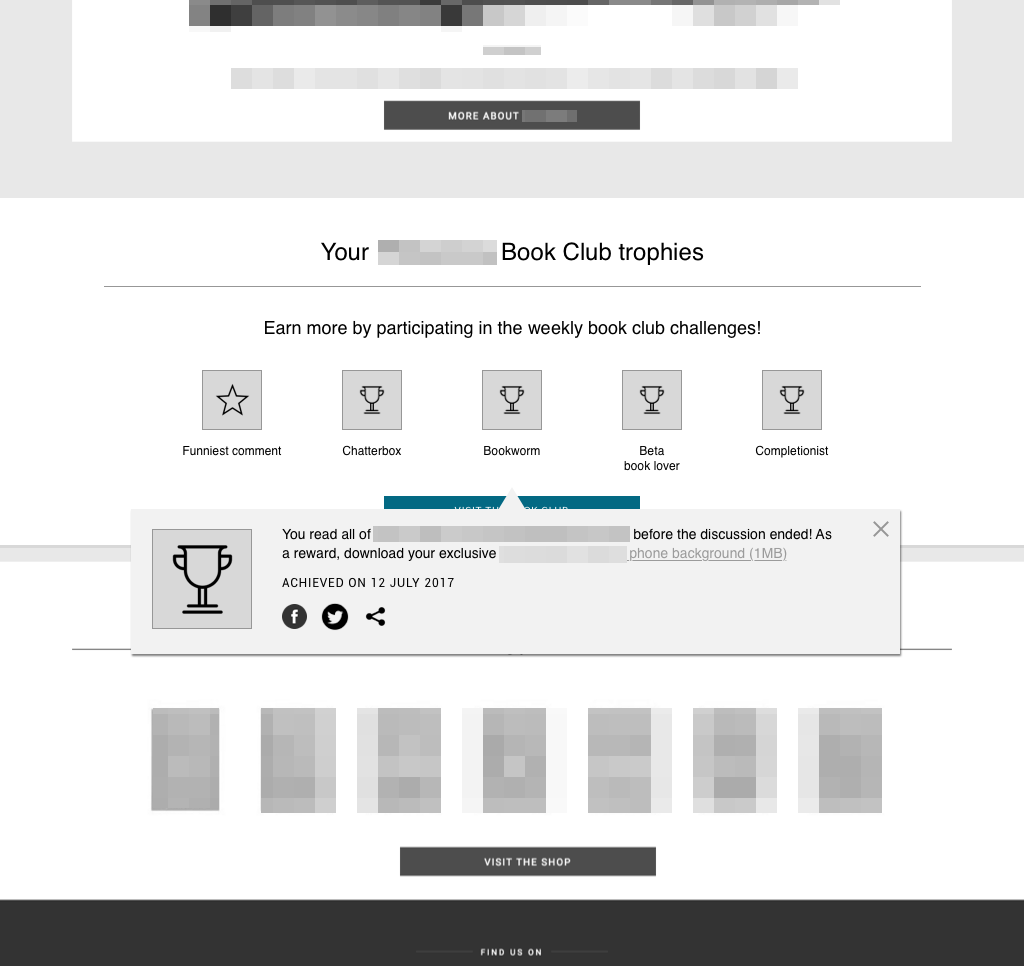
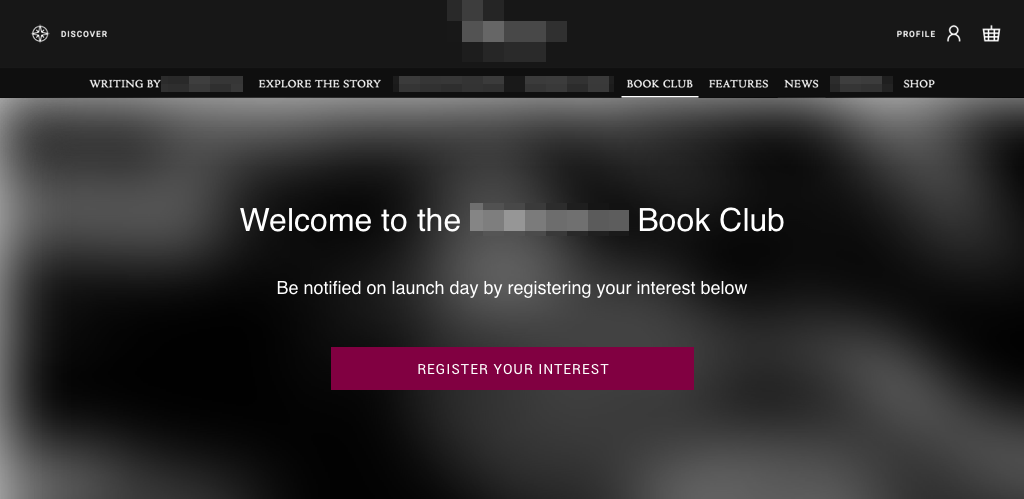
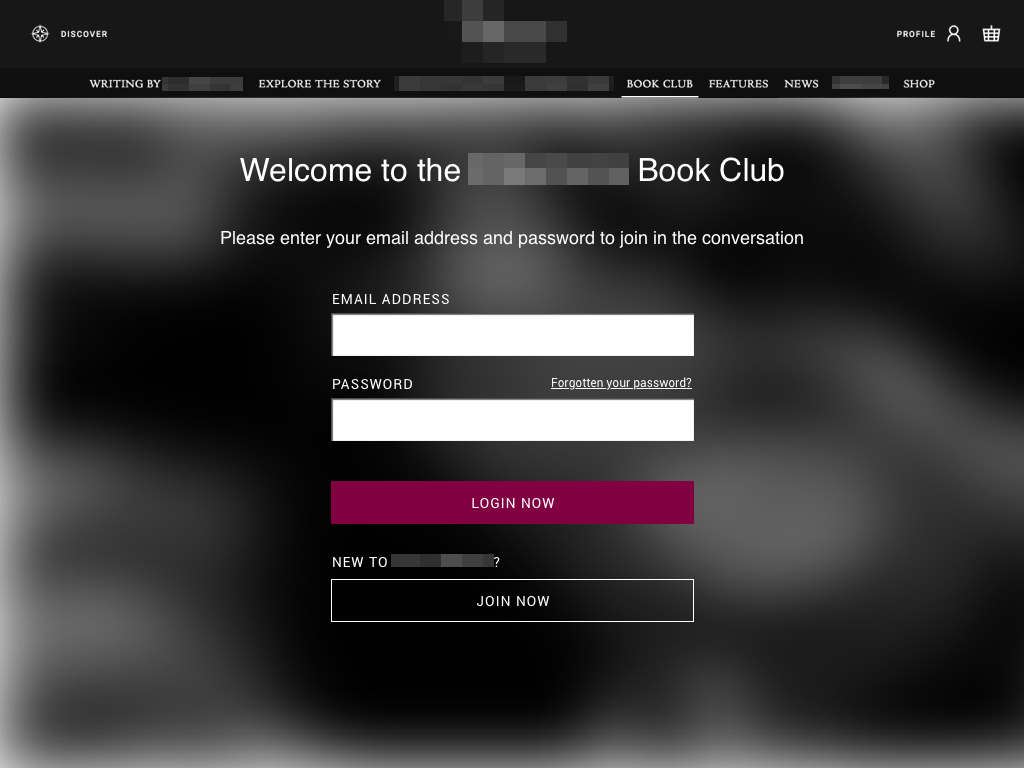
Wireframe and mid-fidelity mockups of book club, coming soon and profile pages
Sadly — as mentioned earlier — it was at this point that I had to leave the contract due to some pretty devastating personal circumstances. I’m happy to see that the service has continued to evolve since I left, and, if they read this, I want to thank the team for being so understanding at the time.