
Project Description
It’s the curse of success — the bigger your organisation becomes, the more it does, and often the harder it is to understand the true experience your customers have. Feedback forms, customer satisfaction surveys and metrics only tell you so much about your customers’ experience with the brand, and there are myriad opportunities that can be overlooked. Additionally, quantitative research projects are expensive and time-consuming. So to the challenge: to understand where the CX problems are and what should be done about them, quickly and cost-efficiently.
If we’re totally honest with ourselves, companies often look to create journey maps because they feel they ought to have them. Once they’re created they’re shared, admired for a few days, discussed in a meeting or two, and eventually retired to a shared drive to be forgotten about. For this reason, many journey maps I’ve seen are vague, at a very high level, and don’t really provide anything actionable. Luckily (or unluckily) for this client, myself and my team are quite insistent on creating things that are useful and actionable… which means a far more intense, involved and productive process to create them.
I’ve now led a team of CX Designers / Researchers on 5 of these journey mapping projects for this pharmaceutical company, each with very similar goals and constraints — so I’ll talk about all 5 at once. Four of the projects were for existing, live processes that needed improvement. One was for a new product just going into development, where we could use competitor product experiences combined with the company’s other existing products to create a hypothetical experience with problems to avoid, rather than issues to fix.
The goals:
- To understand all the steps involved with each lifecycle, much of which happens externally to the company
- To identify which scenarios are most important to talk about — where’s the biggest opportunity here?
- To clarify who’s involved with each stage to better understand their relationship with the company (and if they currently have one at all)
- To make sure expectations are being met (and understand where they aren’t) — and to identify where expectations could be set more accurately
- To identify problem areas — where issues often occur, or where people make mistakes
- Finally, and most importantly, to define and prioritise a list of actionable changes that could be made to address problems and improve the customer experience
The constraints:
- Access to end-users and customers is difficult; they are extremely time poor — plus, there’s a global pandemic (I am looking forward to when I can revisit this and amend to, “there was a pandemic”) which limits access to everyone
- The journey needs to take several markets into account; they’re looking for global initiatives that can make a difference to as large a group as possible
- Everything must be conducted remotely; partly because of the pandemic, but also because of the global nature of the work
- All of the projects needed to be completed within 4-5 weeks due to meetings, presentations or product launches that the deliverables were needed for
Stage 1 — Use what you know
Involves:
- Kick-off session with project team
- Review of background documentation
Kickoff session
The start of any successful project — I kick things off by making sure the client and project team knows what we’re going to create, how we’re going to do it, by when, and what we need from them to be able to do so. Because we’re not going to conduct research sessions with any actual customers in these projects, the success depends entirely on the project team supplying us with the information we need as the ‘voice of the customer’.
I also take this opportunity to ask for useful background information and documentation the team can supply; often there are already surveys, studies, metrics, and even how-to guides that can give us much of the practical “what is happening” content for our journey maps, and some of the challenges too. More is always better at this stage, and I ask the project team to provide anything that seems vaguely relevant!
Review background documentation
Once received, we get to work reviewing these existing documents. They are used to:
- Identify some of the significant factors that might impact the scenarios to be prioritised. For example: is the customer new or is there a long-term relationship with the company already? How technologically capable are they? What style of business does the customer operate? Does the customer own a small, family-run business, or are they a manager of a huge enterprise?
- Start to understand what happens in the journeys; the actual steps (and detail) involved that will go into the journey map(s)
- Define potential topics to discuss during subject matter expert interviews (the next stage) and create a more focused conversation to maximise how productive this time is
Stage 2 – Profiles and scenario development
Involves:
- Stakeholder and subject matter expert interviews
- Profiling and validation
- Analysis of significant factors
- Definition of narrative scenarios
Interviews
After designing an interview guide to be used by the team, and after scheduling interviews across numerous time zones (in one project this involved booking 9 interviews with 21 interviewees across 8 different time zones, being conducted by 3 interviewers across 3 different time zones, 2 days before the clocks went back… possibly my greatest organisational achievement to date) — it’s time to conduct interviews. As the Lead on these projects I ensured my team felt comfortable using the interview guides, and that the client was always kept involved and had the opportunity to add (or remove) questions and discussion points where their industry knowledge might help discussions bear more fruit.
Depending on the subject and number of attendees, interviews lasted 1-2 hours, with time balanced carefully between exploring all possibly useful avenues while also covering all the subject matter needed to consistently define the journeys across different markets. Once complete, each interview was written up in full to be used for the proceeding deliverables.
But who are we interviewing? Without easy access to real customers, we speak with the next best thing; subject matter experts and representatives who spend almost all of their working day visiting customers to sell, deliver training, deal with problems, and support their businesses. These subject matter experts actually work as a really useful filter, giving us the most common and highest priority information on behalf of a number of customers based on what they hear most often; if it’s really a problem then these people have got an earful about it from several customers already. By using these SME’s insights, it’s much simpler to identify the key areas and opportunities, which can later have detailed end-user research when the company’s looking to implement a solution.
A note about remote journey mapping
In an ideal world, this exercise would be combined with later workshops in one lovely, manic day in a conference room, with hundreds of post-it notes stuck on every wall and all of our interviewees jumping in and out of groups to populate walls of journey maps at an alarming rate. Alas, in a remote world this just doesn’t work; even using a virtual whiteboard, people are far more apprehensive to jump in and as such this background work makes a huge difference to the quality of the deliverables.
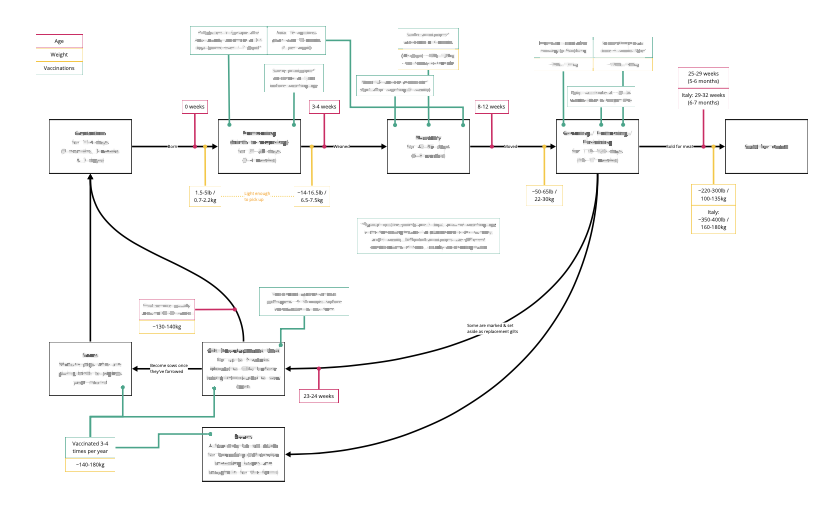
A lifecycle as discovered through research
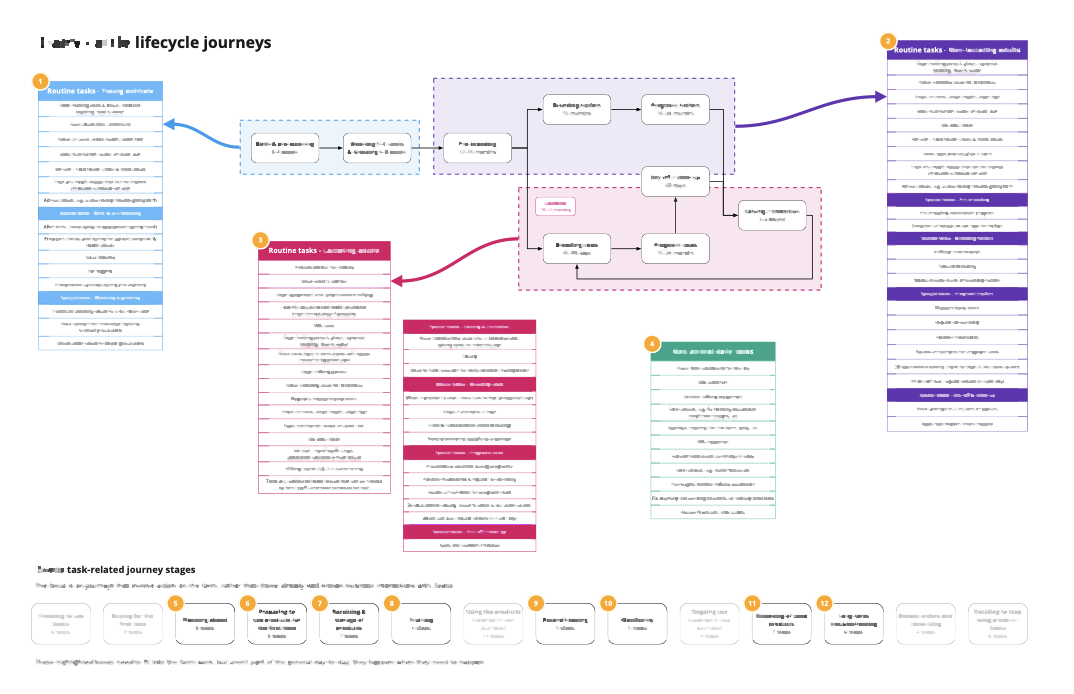
A lifecycle showing how all the journeys fit together
Profiling
It wasn’t in scope to create full, detailed, large-scale research-based personas for these projects; so my team and I used the background documentation and interview detail (plus some of our own internet digging!) to group the different customer/user characteristics into profiles that could be referenced in each of the scenarios and journey maps. Attitudes, aptitudes, behaviours and responsibilities were affinity mapped until a set of distinct profiles emerged, which were validated and tweaked by the project team. We found that many of these roles applied across all of the journey mapping projects (as they were all for the same company), so we were able to expand upon these rather than reinventing the wheel each time.
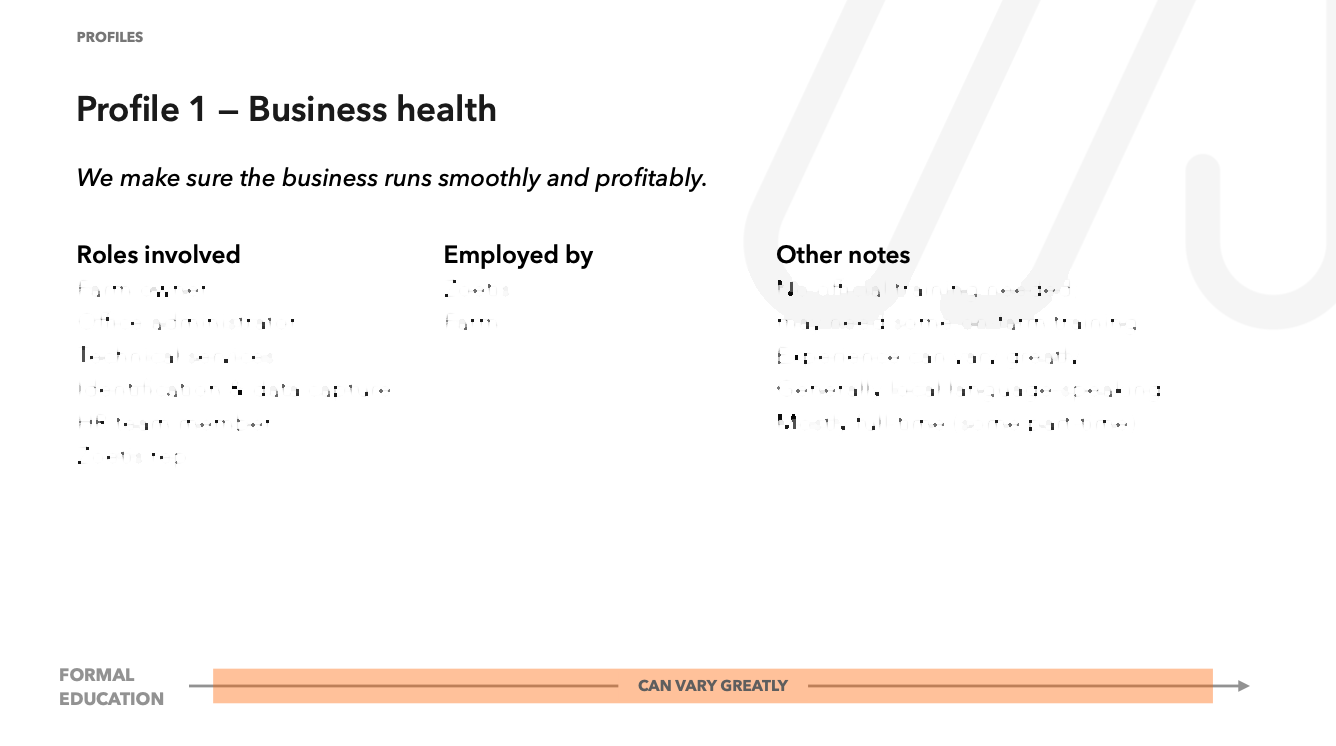
Business health profile
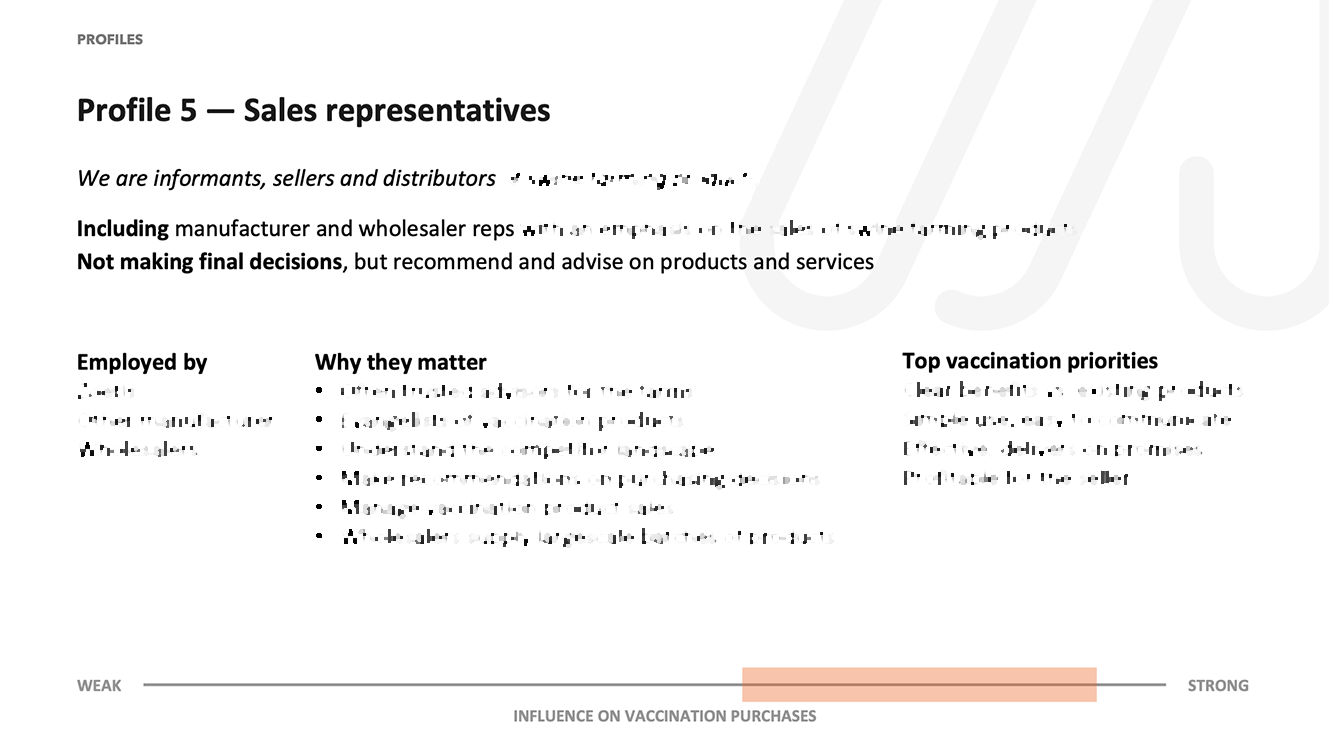
Sales representative profile
Significant factors & scenarios
Significant factor analysis is a rather grandiose term for listing all of the possible variables in a huge spreadsheet (e.g. whether or not they’re an existing customer, what type of business they’re working in, how good the customer is with computers) — and then identifying the most important combinations of these to consider as scenarios. First I block out the ones that are mutually exclusive (for example, you can’t be brand new to the company but already own several of their products, or have no internet connection but already manage everything on the cloud), and from there I use what we’ve learnt from the background documents, the research, and the profile validation to identify which are likely to exist, which ones are much less common, and which have the highest stakes. This is the beginning of the scenario development.
Once the likely / problematic / high-stakes combinations of these significant factors are defined, we write a narrative to take back to the project team to narrow down which scenarios are most important to focus on with journey maps. With all the time in the world we could map every interaction through the customer lifecycle with every customer type (buyer, end user, middle manager and so on) — but budgets and timelines exist, so we combine priorities from the research with the business’ values and priorities. For example:
- Customers who are experienced with a competitor offering (but hate it, and want to get rid of it) switching to this company’s offering; they’re skeptical but management are pushing it on them, and the product arrives and needs to be set up and used for the first time — a priority because if the users aren’t engaged then the product will be dropped at renewal time when management realise it’s not used
- Customers who are considering new types of testing but have never used this type of test before who hear about the client’s offering, but also the cheaper competitor products — as an emerging industry it may be imperative to make an impact in the market now
That being said, for some of these projects we were indeed tasked with covering the entirety of the customer lifecycle — from “I’ve never heard of you”, through using the products and services, and all the way to “we’re done here”. It’s achievable, but it’s a lot; and you can only reach a certain level of detail when covering everything. It’s my role as the CX Lead to help clients understand that, and to ensure they’re happy with the choice they make on how to proceed.
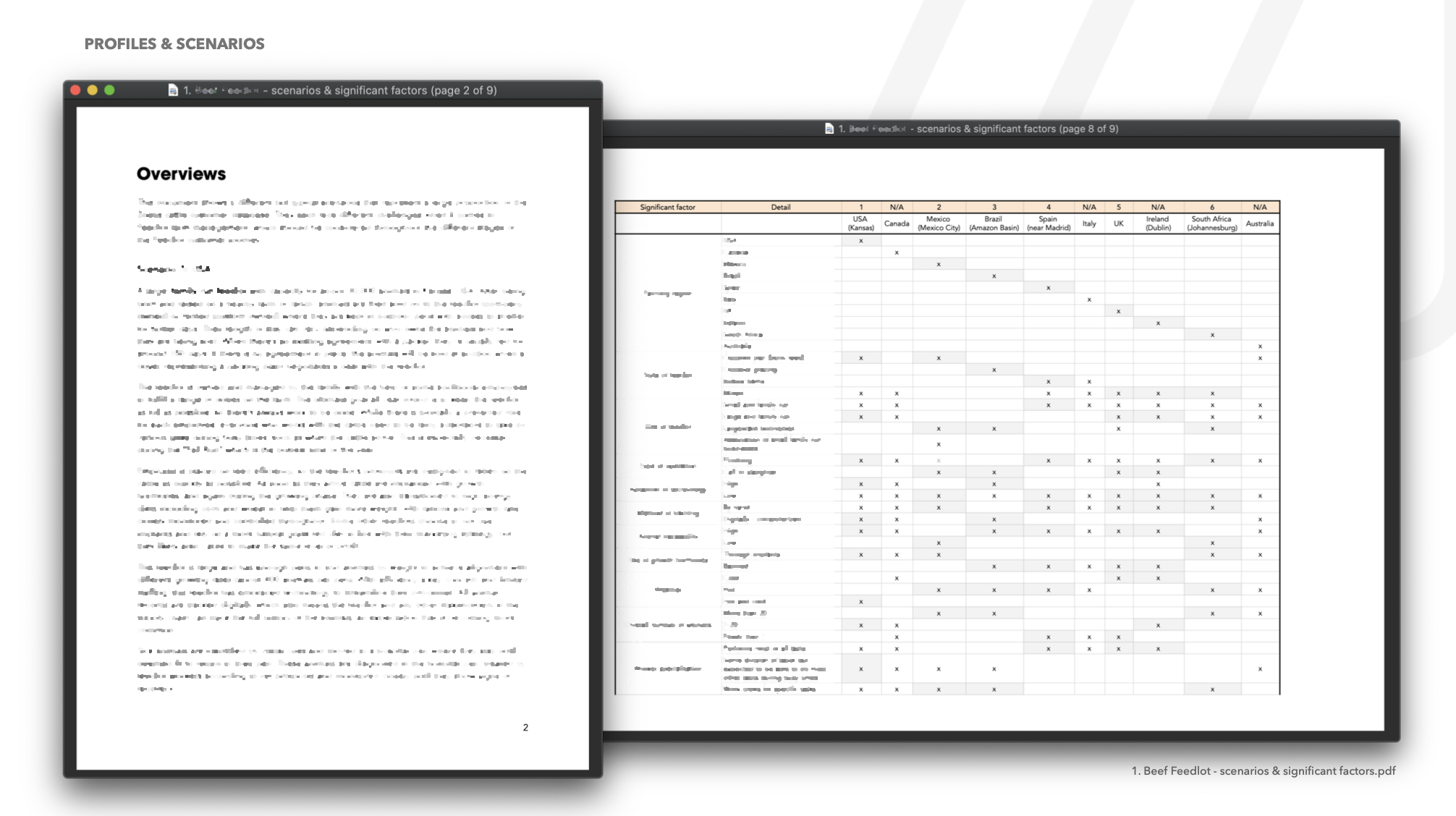
Overview scenarios with their accompanying significant factors spreadsheet
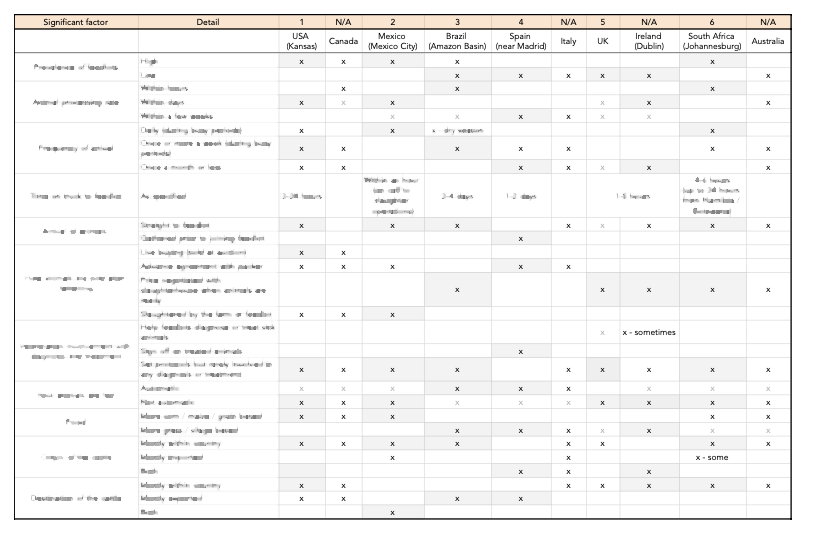
More significant factors
Stage 3 – Journey mapping
Involves:
- Draft journey mapping for each defined scenario
- Brainstorming workshops
Draft journey map(s)
You signed up for customer journeys and we’re finally here! With the scenarios ready to map, much of the ‘what happens’ uncovered, many of the problems discussed and probed into, and even some ideas already identified, my next job is to capture all of this in a comprehensive, end-to-end journey map for each scenario. When I say comprehensive, I mean it. The goal here really is to capture everything and try to make it as digestible (and therefore actionable) as possible. I’m not talking about cute happy-sad graphs with smiley faces! All the detail captured so far is added to a journey in the online collaboration tool Miro, with columns per journey stage, and the following rows for each:
- Stage
- Background and context
- Steps involved
- Expectations customers have
- Expectations we want to set
- Mistakes customers can make
- Challenges and problems
- Opportunities to improve
Additionally, if certain points are only identified for certain markets, these are highlighted with a country code so that we don’t make the assumption that this applies to everyone. Skip to stage 4 to see some finished examples of these.
Workshops
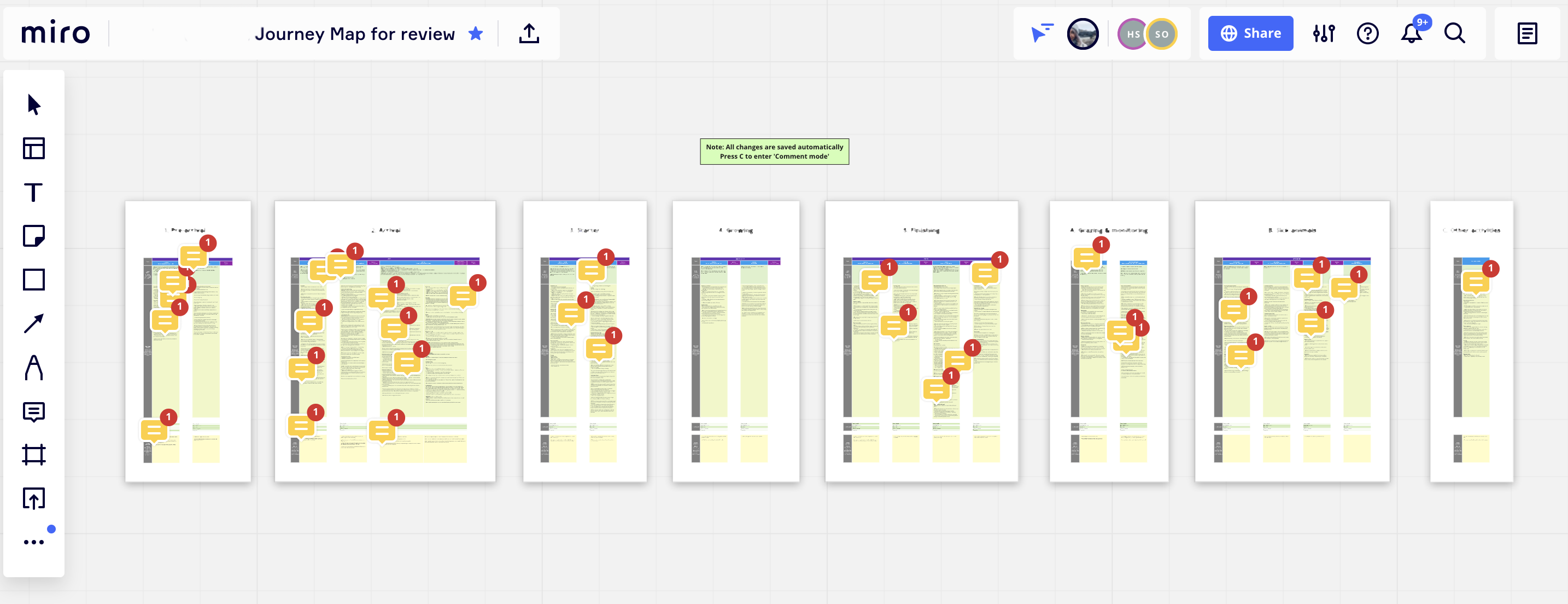
Pre-reading is sent round to the project team (including those people who have been interviewed) which sets out what we know about the different profiles, contains an agenda for the workshop, and also the journey map on a comment-able Miro board — down to the ‘expectations customers have’ row. This gives the attendees the opportunity to add comments via Miro for anything we could have missed, additional clarification, or places where a point has been assigned to only one market but applies to others too.
I sent out the entire journey map for review for the first couple of projects, but soon realised that attendees found this totally overwhelming and as such, gave up. The image below shows this reduced journey map in Miro, with a number of comments from the project team prior to the workshops.
The goals (and structure) of these workshops are as follows:
- As a group, ensure we’ve captured all of the possible mistakes that could be made throughout the journey, and the challenges and problems that customers face
- Using these, come up with as many solutions and opportunities as possible to either mitigate the problems or enhance the experience with additional value
While some of the challenges had already been captured in the interviews, doing these two stages in a group setting works really well — attendees can bounce ideas off each other and come up with suggestions that they might not have reached alone. The sessions are split into groups of 5-8 to ensure everything can be covered, and everyone gets an opportunity to speak.
Stage 4 – Prioritise opportunities
Involves:
- Final journey map(s)
- Backlog of prioritised opportunities
- Final presentation and recommendations
Journey map(s)
After the group discussion(s), it’s time to take everything we’ve heard and populate the final journey map. By this time — if you’ve done it right — the journey map is really quite terrifying to look at. It’s huge, it’s covered in loads of text, and you wonder how you’ll possibly do anything with it. This is exactly why “creating a journey map” should never be the end goal of a journey mapping exercise!
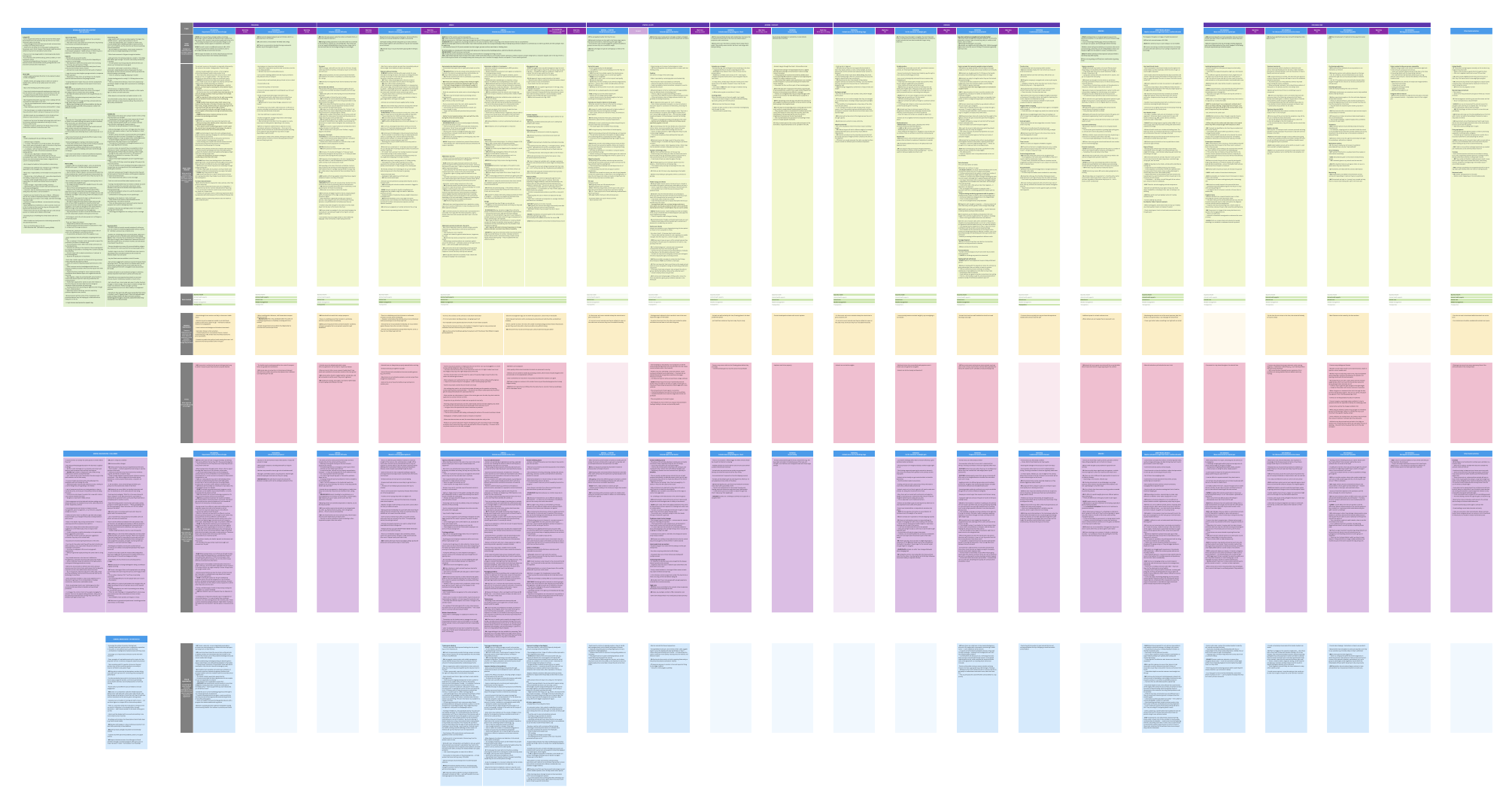
An example journey map. Even at this level, you can see which stages of the journey are most problematic (i.e. columns that have loads of text!)
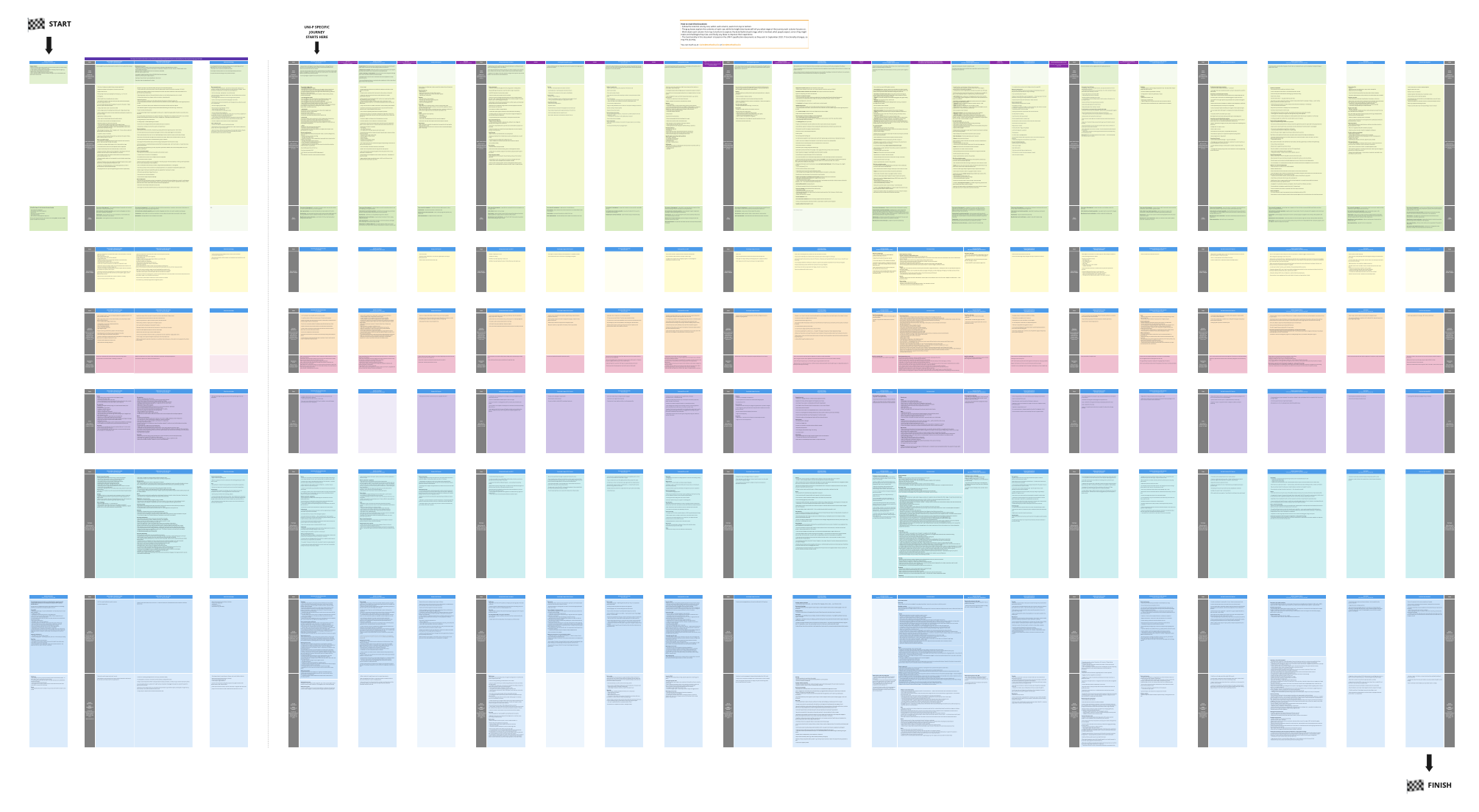
Another example! I promise I haven’t just changed the colours…
Prioritised opportunities
From this scary map, I pull out not just the opportunities, but also the challenges, errors and expectations, and put them all into a spreadsheet. Problems are matched up with opportunities to see where the gaps still exist; some of which might be easy/obvious fixes, while others will be flagged as needing further investigation. I note which stage(s) of the journey map each has come from so that future readers can check back for context, categorise by type (e.g. marketing, training, new product) as initiatives will likely be split by business function, and finally prioritise each item against the amount of effort it will take to implement versus the impact it’ll have on customers. These measures are imprecise, but with years of experience in digital product development, combined with a couple of years with this client, they’re pretty good estimates.
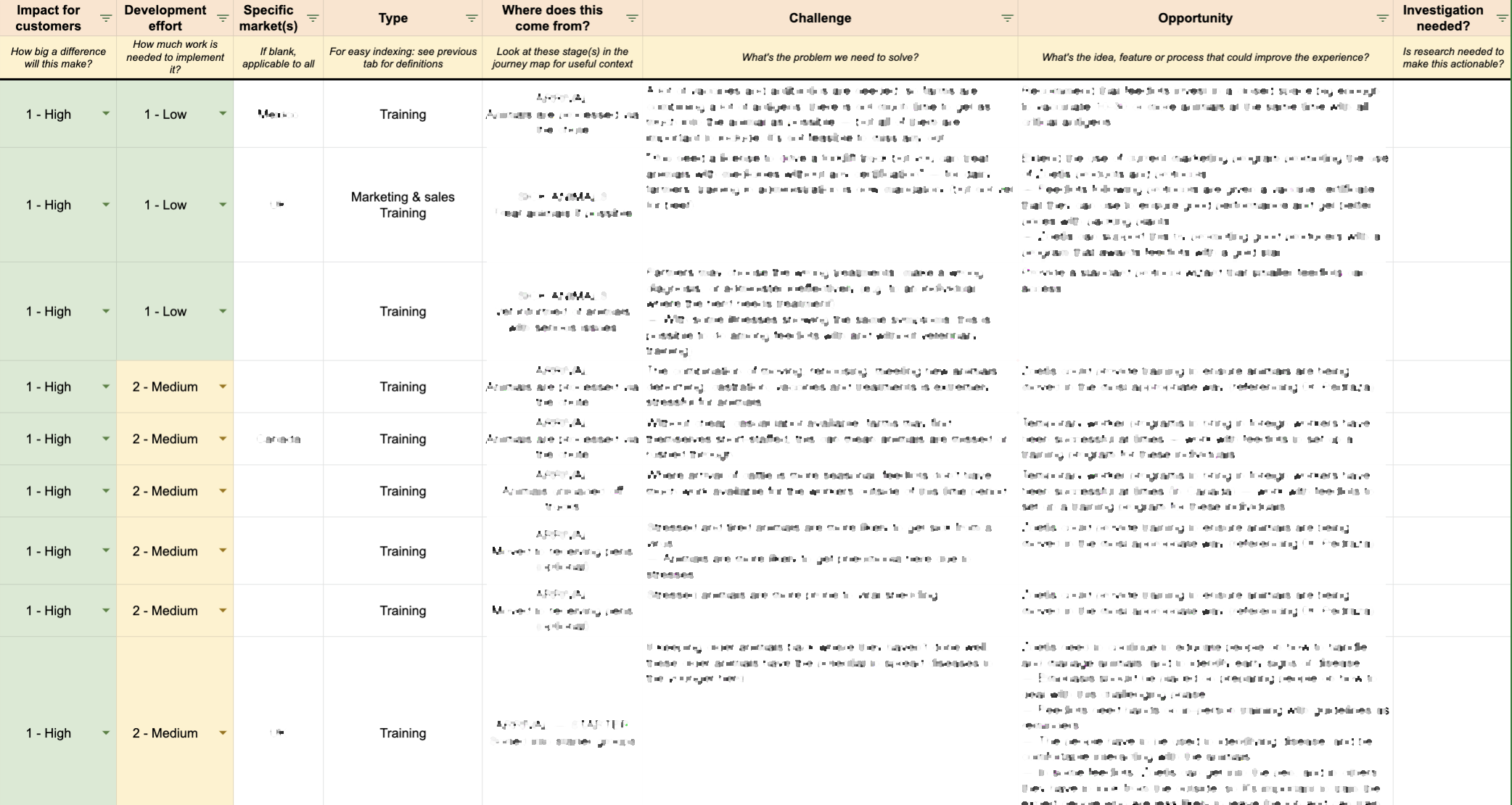
The ‘Training’ tab in a prioritised opportunities spreadsheet
Final recommendations
You’ve made it here! Congratulations! While it took a lot of work to arrive here, this stage of the project might be the only bit a lot of people see. I totally get it — not everyone is as passionate about these journey maps as me. It doesn’t make any sense, but I’ve come to accept it now. For that reason, I also understand that not everyone wants to look through the spreadsheet (even if I did colour-code it and add some nifty filters). As such, the final deliverable is a presentation/summary deck containing the following:
- A walkthrough of the project and methods used
- Profiles
- High level scenarios
- An explanation (and screenshot) of the journey map
- An explanation (and screenshot) of the opportunities spreadsheet
- And most importantly: the high-level themes and most important opportunities to action, per opportunity type (marketing, training, etc)
I conduct a final handover meeting to ensure the project team is comfortable and happy with all of their deliverables, and that’s it! Of course, I’m still reachable just in case the client has any quick questions — or, as often happens, when they want more journey mapping for something else!
Claire is a rare beast indeed — an incredible communicator, a fantastic designer, and with organisational chops to boot. She’s a hoot to work with, but if you need her to she can take thorny jobs off your hands and return with polished work and a host of new fans for you and your work with her. If you have even the hint of a chance to work with her, take it.